| 1932 - 1933 -- Second International Polar Year. |
| 1937 -- Veryl Fuller and Ervin Bramhall publish a paper on research in which
they determined the height of the aurora. Their work, based at the University of
Alaska helped convince Congress to authorize creation of the Geophysical Institute
nine years later. |
| Fuller, Veryl R. and Ervin H. Bramhall. 1937.
Auroral Research at the University of Alaska, 1930-1934. Volume III.
Miscellaneous Publications of the University of Alaska. College, Alaska. 130 p. | | |
 |
 |
 |
 |
 |
| Chapter I, p.14 |
Chapter II, p.36 |
Chapter III, p.70 |
Chapter IV, p.78 |
Chapter V, p.88 |
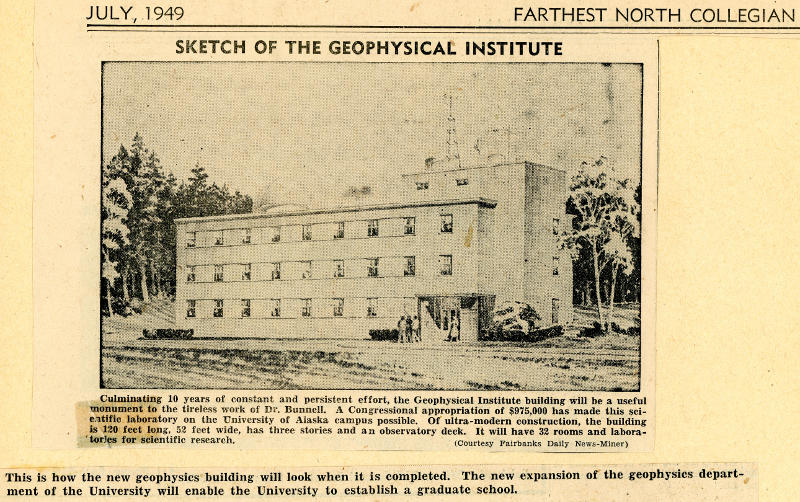
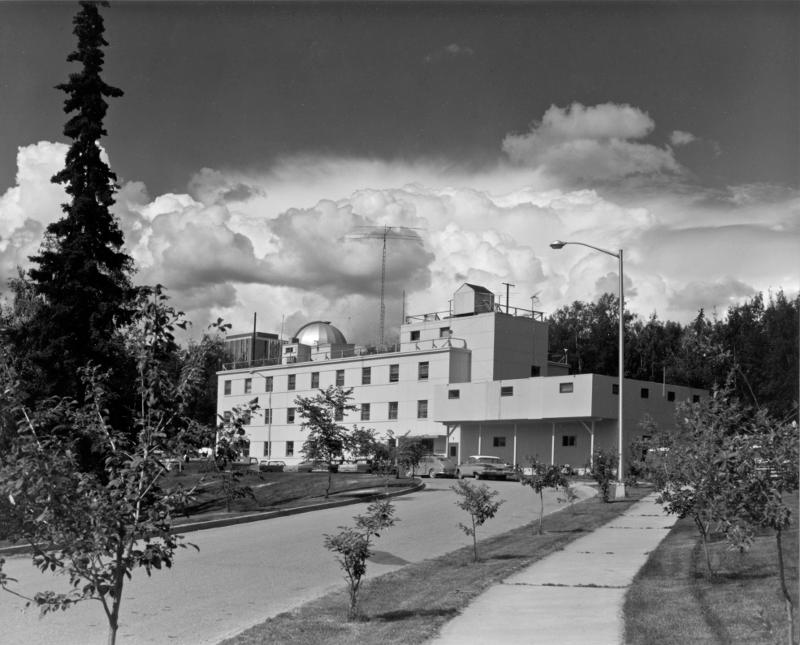
| 1946 -- The U.S. Congress authorize an appropriation for the establishment of the Geophysical Institute. |
|
| Law establishing the G.I. -- Public Law 580,
H.R. 6486, July 31, 1946. |
| 1948 -- Auroral height study resumes. |
 |
| Stuart Seaton |
| 1949 -- Stuart Seaton hired as the first Geophysical Institute director. |
| 1950 -- Seaton reigns over a funding battle with university president Terris Moore. Most Institute staff resign with Seaton. Moore appoints University Chemistry Professor William Wilson as director. |  |
| William Wilson |
|
| 1950 -- Close relationships are found between geomagnetic distrubances, auroral activity, and radio wave interference. |
 |
| Sydney Chapman |
| 1951 -- Wilson recruits Sydney Chapman to serve as advisory scientific director and
visiting professor. |
| 1954 -- First GI PhD conferred to Masahisa Sugiura. |
| 1957 -- GI faculty make the first official North American sightings of Sputnik and record its radio signal. An optical observatory is built near Ballaine Lake. |
 |
| all-sky camera |
| 1957-1958 -- During the International Geophysical Year (IGY), T. Neil Davis and Elvey developed the all-sky camera. |
 |
| debrise fireball and air glow |
| 1962 -- In conjunction with Starfish Prime, a 1.4 megaton exoatmospheric nuclear detonation at 400km altitude conducted by the Defense Department and the Atomic Energy Commission, magnetic and optical effects of the detonation are observed and measured by Geophysical Institute researchers. |
| 1963 -- Australian scientist Keith Mather is named director. |
 |
| Keith Mather |
|
| 1964 -- The second largest earthquake on record occurs in Alaska's Prince William Sound on March 28th. A GI investigation of this great earthquake helps to document the event. |
| 1967 -- Auroral Airborne Expeditions begin: jet aircraft observations confirm and aid the study of the northern auroral oval, a continuous band within which the visible aurora lies, which had been inferred since 1963. |
 |
| First Poker Flat Launch |
|
1969 -- The first rocket was launched at Poker Flat Research Range, the brainchild of T. Neil Davis. |
| 1971 -- A GI team coordinates and executes conjugate observations of a shaped-charge barium relates -- the GI's first - over Kauai, Hawaii, which traces out 7000 km magnetic field line and affirms models of field line dimensions. |
| 1975 -- 100th sounding rocket launched from Poker Flat Research Range. |
| 1976 -- T. Neil Davis Becomes acting director. |
 |
| T. Neil Davis |
|
 |
| Juan Roederer |
| 1977 -- Juan Roederer, recruited from the University of Denver, becomes director. |
| 1978 -- New observatory on the Island of Svalbard, Norway is established for observation of daytime aurora. |
1984 -- Research splits into three distinct divisions:
- Space Physics
- Atmospheric Sciences and Glaciology
- Solid Earth Geophysics
|
| 1986 -- Syun-Ichi Akasofu succeeds Dr. Roederer as director. |
 |
| Syun-Ichi Akasofu |
|
| 1989 -- The GI's Alaska Volcano Observatory successfully forecasts the Redoubt eruption; their Puff Tracking Model describes the subsequent distribution of resultant airborne aerosols. |
| 1991 -- Work begins on the High-Altitude Auroral Research Project (HAARP) ionospheric heater in Gakona. |
| 1993 -- Red sprites, flashes of light in the ionosphere above thunderstorms are determined to be a D-Region phenoment. |
| 1995 -- T. Neil Davis Science Operations Center is completed at Poker Flat Research Range. |
| 1997 -- The Okmok eruption becomes the first to be discovered solely by satellite observation. |
|
| IARC |
|
1999 -- The International Arctic Reserach Center (IARC) opens. Akasofu moves next door to serve as its founding director. |
2000 -- After an international search, Dr. Roger Smith, professor of physics is named director of the Geophysical Institute. |
|
| Roger Smith |
|
*Adapted from the GI Quarterly, Vol. 16, No. 3, 2000 published
by the GI Information Office.
Updated, Spring 2006. Web Coordinator
|
|
|
|
|
|
|
|
|
|
|
|
|
|
|
|