Leading the Way in Addressing Arctic METOC Challenges and Working Together to Find Solutions
The Arctic METOC Partnership Summit (AMPS) 2026 will be held March 23-27, 2026, at the Wood Center (March 23-26) and the Geophysical Institute (March 27), both located on the University of Alaska Fairbanks. There will be an Icebreaker Dinner at the Antique Auto Museum on Tuesday, March 24, from 6-9 p.m.
Executive Summary:
The Arctic METOC Partnership Summit 2026 (AMPS 2026) is a critical gathering uniting tactical, operational, and strategic METOC experts to address pressing data and knowledge gaps in Arctic forecasting. Held in Fairbanks, Alaska, from March 23-27, 2026, this summit will foster collaboration between government, academia, NATO partners, and Indigenous communities to enhance safety, security, and operational effectiveness in the Arctic region. By sharing expertise, leveraging innovative technologies, and incorporating traditional knowledge, AMPS 2026 will drive advancements in Arctic METOC capabilities and directly support NATO nations' Arctic Strategies. This summit will focus on two critical areas: 1) The limited availability of standardized METOC Tactics, Techniques, and Procedures (TTPs) for the Alaska/Arctic region; and 2) The need for specialized training and knowledge to adapt forecasting techniques to the unique conditions of the Arctic, which differ substantially from mid- and low-latitude environments.
Mission:
To unite tactical, operational, and strategic METOC experts in a collaborative effort to bridge critical data and knowledge gaps in Arctic forecasting, directly supporting NATO nations' Arctic Strategies and enhancing safety and security in the region.
Problem Statement:
Arctic METOC data collection and forecasting face significant challenges. This workshop will focus on two critical areas: 1) The limited availability of standardized METOC TTPs for the Alaska/Arctic region, hindering operational effectiveness; and 2) The need for specialized training and knowledge to adapt forecasting techniques to the unique conditions of the Arctic, which differ substantially from mid- and low-latitude environments.
Location and Time:
AMPS 2026 will be held in Fairbanks, Alaska, from March 23-27, 2026. Located near key Arctic research institutions, Fairbanks provides an ideal setting for this 5-day workshop featuring speakers, discussion panels, working group meetings, tours, networking opportunities with researchers from the University of Alaska Fairbanks (UAF) Geophysical Institute and International Arctic Research Center, and an Arctic Innovation Day.
Desired Outcomes:
Foster networking and cooperation between Arctic research universities, government forecast offices, research laboratories, contractors, NATO partners, and the military to initiate or continue mutually beneficial Research to Operations to Research (R2O2R) activities.
Establish and strengthen partnerships between civilian and military organizations facing similar Arctic forecasting and training challenges (e.g., numerical modeling), promoting collaborative solutions to avoid duplication of effort.
Incorporate the valuable climate impact observations and forecasting techniques of Alaska Natives, recognizing their lifetime of experience in data-sparse Arctic regions.
Implement an Arctic Innovation Day to enable STEM students and UAF researchers to present their research and innovative solutions for high-latitude METOC, space weather, and infrastructure challenges, directly addressing METOC requirements outlined in Arctic Strategies.
Establish an Arctic METOC TTPs Working Group to standardize and improve operational procedures.
Scope Statement (Workshop Objectives):
Enhance Transparency: Increase awareness of high-latitude METOC products and data availability from DoD, government, university, and NATO sources, including their capabilities, strengths, weaknesses, and specific requirements.
Strengthen Relationships: Foster increased collaboration for R2O2R initiatives by strengthening relationships between government, university, international partners, and DoD METOC entities.
Accelerate Innovation: Review progress from the Alaska Arctic Sensing Strategy and Arctic Weather Training Working Groups. Identify areas for continued collaboration to address data gaps and leverage technologies like AI and Machine Learning to improve data availability and forecast accuracy. Evaluate the need for additional working groups to address specific METOC challenges.
Integrate Indigenous Knowledge: Engage with Alaska Natives to gain insights into their unique perspectives on climate, observations, and forecasting in the Arctic. Integrate their traditional knowledge of high-latitude weather patterns to enhance Homeland Defense operations.
Assumptions:
This summit builds upon the collaborative foundation established during previous Arctic Weather Workshops (AWW22, AWW24) and AMPS 2025, which facilitated critical information sharing and networking between DoD, government, university, and NATO entities.
Updates from the existing Arctic Sensing Strategy and Arctic Weather Training Working Groups will be presented. The summit will also explore the potential for establishing new working groups or refining existing ones to address emerging METOC gaps.
Addressing the complex data and knowledge gaps in Arctic forecasting requires a collaborative approach, leveraging the resources and expertise of multiple organizations. Furthermore, integrating the traditional knowledge of indigenous communities is crucial for enhancing forecasting accuracy in data-sparse regions.
Registration
Registration is now closed. Please let Gail Weaver, gail.weaver.1@us.af.mil, know by Friday, Feb. 27, if you'd still like to register.
The payment site for registration is open! The registration fee for AMPS 2026 is $275.00 USD and is due by Friday, March 6. This non-refundable registration fee covers administrative costs, snacks, beverages, and lunches. A discounted fee is available for NOAA, NWS, students, and university researchers. This discounted fee does not include snacks, beverages, and lunches.
There is a separate cost ($35 for dinner for AMPS attendees; $35 for dinner plus $18 for museum entrance fee for a total of $53 for each guest) for the Icebreaker Dinner.
Questions about the Summit? Please contact Gail Weaver, gail.weaver.1@us.af.mil, or MSgt Doug Ledbetter, william.ledbetter@us.af.mil.
- Zoom recordings
- Day 1 (March 23)
- Day 2 (March 24)
- Day 3 (March 25)
- Day 4 (March 26) — Please email Sara Wilbur, smwilbur2@alaska.edu, for access to the Day 4 recording
- Day 5 (March 27)
- Agenda
- View the final agenda (as of 20 March 2026).
- Arctic METOC Initiatives
- The Arctic Weather Workshop (AWW) and Arctic METOC Partnership (AMPS) initiatives led to the establishment of the Arctic Sensing Strategy Working Group, Arctic Training Working Group, and the creation of comprehensive METOC (Meteorological and Oceanographic) analyses.
- Read the initatives' key accomplishments.
- Presentations
- Monday, 3/23
- Col Russ Vanderlugt, Army Aviation in the Arctic
- Mr. Edward Alexander, The Circumpolar Wildland Fire Crisis: Cascading Impacts and Solutions
- Dr. Jessica Larsen, Research at the Intersection of Ring of Fire & Aurora Oval
- Dr. David Schuster, GDNP UARC Overview
Tuesday, 3/24- Mr. Drew Messina, WindBorne: Building a planetary nervous system
- Ms. Heather Gilbert, Canadian Arctic Prediction System (CAPS)
- Dr. James Doyle, Using ML Models for Forecast Sensitivity and to Inform Arctic Observing Networks
- Mr. Forest Cannon, Impact of the Tomorrow.io Microwave Sounder Constellation in AI Weather Models
- Mr. Gene Pestrescu, Upcoming NWS Model Guidance Changes
- Mr. Evan Kutta, National Weather Service, Fairbanks, Alaska
- Mr. Brendon Hoch, Arctic (& Subarctic) Zonal Characterization & Operational Thresholding (AZCOT) Briefing
- SMSgt Jonathan Samolinski, 14th Weather Squadron Mission Brief
- Wednesday, 3/25
- Ms. Sofia Montalvo and Ms. Britney Fajardo, METOC Impacts on Operation Ice Camp Camp Boarfish
- Maj Thomas Maaske, NATO Arctic Discussion Panel
- Ms. Caroline Harten, ASAPS Arctic Airborne Observations
- Dr. Anna Wagner, Snow Trends in Interior Alaska & More
- Dr. Cathy Cahill, North to the Future – Alaska as a Strategic Testbed for Arctic Unmanned Aircraft Systems
- Dr. Franz Meyer, ASF: Enabling SAR Science, Applications & Capacity Building
- Thursday, 3/26
- Arctic Forecasting and Operational Support Challenges
- 16th Weather Squadron
- Dr. Satya Kalluri, NOAA LEO Observation Strategy
- Dr. Jen Delamere, Delivering NOAA Wx Satellite Data From the Final Frontier to the Last Frontier
- Jenny Valentine, MARK IV-B Tactical Weather Forecasting Program
- Mr. Ryan Wade, NASA Earth: NASA Arctic Sensing and R2O Transition with SPoRT
- Global Hydro Information Panel
Friday, 3/27- Capt Casey Reynolds, Observational Analysis of Large-Scale Atmospheric Controls on Regional Surface Mass Balance of the Greenland Ice Sheet Using the SUMup Database
- Dr. Pascal Buri, The Impact of Sublimation on the Depletion of Seasonal Snow at High-Latitudes
- Dr. Andy Mahoney, Ground-based radar for situational awareness of sea ice stability
- Dr. Achille Capelli, Drone-based operational reconnaissance of sea ice thickness
- Mr. Barrett Flynn, Enhancing Arctic Decision-Making with Interpretable AI Bathymetry (lakes to near-shore)
- Dr. Kabir Rasouli, Climatological Terrain Accessibility Mapping Using Soil and Snow Conditions
- Ms. Anna Costa, A tool for high-resolution stochastic climate downscaling in Alaska
- Mr. Logan Borger, Continuous River Intelligence for Arctic Operations
- Dr. Peter Webley, UAF Center for Innovation
- Arctic Innovation Day Abstracts
- Buri et al.: The Impact of Sublimation on the Depletion of Seasonal Snow at High-Latitudes
- Capelli et al.: Drone-based operational reconnaissance of sea ice thickness
- Crews et al.: Versatile microSWIFT wave buoys support nearshore Arctic operations
- Mahoney et al.: Ground-based radar for situational awareness of sea ice stability
- Reynolds and Strong: Observational Analysis of Large-Scale Atmospheric Controls on Regional Surface Mass Balance of the Greenland Ice Sheet Using Ice Cores
- Webley et al.: Building the next generation of entrepreneurs, innovations, and dual-use solutions – The Regional Innovation by Scaling Entrepreneurship via University Partnerships Program
- Speaker bios
- Parking on the UAF campus
- Parking passes for UAF campus lots are obtained at kiosks. Parking is $1.25 per hour and $6 per day. Visit this page for more information on campus parking.
- If you paid for parking on the payment page, you will receive your pass(es) via email the week before the summit.
- View the UAF campus map here. The location for March 23-26 will be the Wood Center. Please park in Lots 4D, 4F and 4F to take the provided shuttle bus to the Wood Center. The location for March 27 is the Elvey Building, and the preferred parking area for Elvey is Lot 9B.
- Official AMPS 2026 Icebreaker Dinner
- There will be an Icebreaker Dinner at the Antique Auto Museum on Tuesday, March 24, from 6-9 p.m.
- There is a separate cost ($35 for dinner for AMPS attendees; $35 for dinner plus $18 for museum entrance fee for a total of $53 for each guest) for the Icebreaker Dinner. You can make your Icebreaker payment on the AMPS payment site.
- Lodging and per diem
- The AMPS 2026 planning team has secured a room block at Sophie Station Suites with a room rate of $179/night. This rate will be available from March 21-28, 2026. Reservations must be made no later than March 1, 2026, to obtain the discounted room rate.
- Sophie Station Suites is an all-suite hotel. The rooms include a full kitchen, breakfast bar, living room, balcony, bedroom with 2 queen beds or 1 king bed, vanity area and a full spacious bathroom. Zach's Restaurant and Lounge are located on the second floor. The hotel also has laundry facilities and free internet available to our guests. The check in time is 4:00 p.m. and check out time is 11:00 a.m.
- To make a reservation at Sophie Station Suites:
- Read the Reservations letter provided to attendees.
- Reservations must be made by calling the Reservations Department directly at 907-456-3642 or 800-528-4916. Please mention Group name AMPS 2026 when making reservations. The group code is not available for reservations booked online.
- Additional guests are $10/per person/per night.
- Reservations must be cancelled 24 hours prior to arrival to avoid any penalty.
- Visit this page for Alaska per diem rates.
- Low-Earth Orbiting Satellites Workshop
- Agenda for the LEO Workshops.
- Learn about the unique benefits of Low-Earth Orbit (LEO) weather satellite data in this hands-on, 2-hour training session on Thursday, March 26, 2026, from 1-3 p.m. AKDT. Taught by NOAA satellite product trainers, this free event will demonstrate how LEO data can enhance operational forecasting and research in the Arctic. Operational weather forecasters and researchers from all backgrounds are welcome; participants should bring a laptop. This workshop is supported by the NOAA Office of Low Earth Orbit Observations.
- Sign up for this workshop in the registration form. Group size is limited to 35 participants.
- Tours and other places to visit
- Permafrost Tunnel Research Facility — The Permafrost Tunnel is situated near the valley floor of Goldstream Creek, 16 miles north of Fairbanks in Fox, Alaska. It was excavated into a man-made escarpment, and is approximately 110 meters in length, 2 to 2.5 meters high, 4 to 5 meters wide, and 15 meters below the surface. The Permafrost Tunnel is an active underground laboratory available for a variety of research programs. Each year, CRREL welcomes many research scientists and engineers interested in conducting research on the processes and properties of frozen soils.
- Poker Flat Research Range — Poker Flat Research Range is perfectly located in Interior Alaska. From this site, rockets can launch and fly over the sparsely populated tundra hundreds of miles north of the range with special permission from federal, state and tribal landowners. Additionally, the range is situated beneath the auroral oval – a ring across the circumpolar north where auroras typically occur – providing ample opportunities to continue scientists’ examination of the aurora. Most sounding rocket launches occur between January and March and scientists come from around the world to use the facility for their research projects.
- Geophysical Institute — Since it was established by an Act of Congress in 1946, scientists at the Geophysical Institute have studied geophysical processes from the center of the Earth to the surface of the sun and beyond, turning data and observations into information useful for state, Arctic and national priorities.
- International Arctic Research Center — By the 1990s, climate change had become an important subject that urgently needed international study. IARC was founded in 1999 at UAF through an agreement between Japan and the United States “to demonstrate our ability to solve, jointly, problems that are beyond what any one nation can address” as outlined in the agreement signed by President Clinton and Prime Minister Hashimoto in 1997.
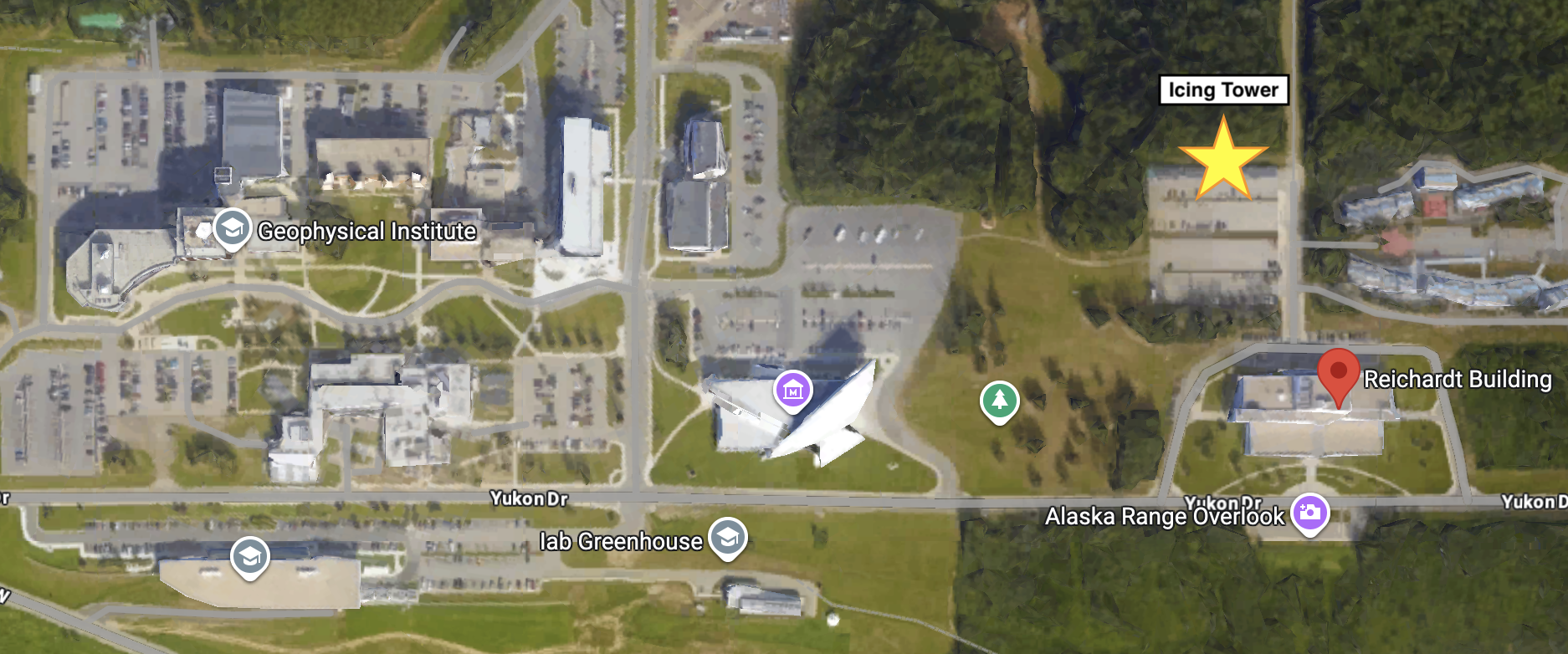
- Supercool Water Experimental Arctic Tower — The Supercool Water Experimental Arctic Tower (SWEAT) is a unique tower built in Fairbanks, Alaska, that enables testing of multi-copters (drones) while hovering in hostile Arctic conditions, such as icing. When such conditions occur, supercooled water droplets accrete onto propellers, either reducing the aircraft's performance or rendering it completely unable to fly. SWEAT is located south of the Reichardt Building on the UAF
Campus (see map to right). - UA Museum of the North — The museum's research collections — 2.5 million artifacts and specimens — represent millions of years of biological diversity and thousands of years of cultural traditions in the North. The collections are organized into 10 disciplines (archaeology, birds, documentary film, earth sciences, ethnology/history, fine arts, fishes/marine invertebrates, insects, mammals, and plants) and serve as a valuable resource for research on climate change, genetics, contaminants and other issues facing Alaska and the circumpolar North.
- Ice Alaska — The Ice Alaska World Ice Art Championships began in Fairbanks, Alaska in 1990 for artists to share ice sculpture experiences for the community. The tradition of the ice sculpting competitions began with the early celebrations of spring, involving ice thrones for the winter carnivals of the 1930s and providing an outdoor activity for local Alaskans to enjoy. Now the Ice Alaska Winter Carnival has evolved into a six-week event full of amazing art pieces and wonderful winter fun.
- Transportation
- Sophie Station Suites offers a courtesy 24-hour shuttle service from the airport to the hotel. Upon arrival, call 907-452-1442 for the shuttle.
- For those staying at Sophie Station Suites, there will also be a shuttle service between the hotel and the university.
- View Fairbanks ground transportation options. Services like Uber and Lyft are unreliable in Fairbanks.
- Food options
- For other meals there are many nearby off-campus dining options, including many on College Road near the University of Alaska Fairbanks.
- Breakfast
- Little Owl Café, Lulu's Bread and Bagels, House of the Rising Bun, Wood Center (UAF) dining options
- Dinner
- Pad Thai Restaurant, Lemongrass, East Ramp Pizza, Pump House, Lavelle's Bistro
- Other resources
- Google Map of downtown Fairbanks
- Explore Fairbanks — Includes things to know for planning your trip (FAQ, weather, hours of daylight, attractions, aurora viewing, etc.)