Skip to main content
Shop
Donate
UA Directory
Intranet
Quick Links
Geophysical Institute
Main navigation
Home
About
Contact Information
Contact
UAF Directory
Visitor Information
About the GI
Community
GI Publications
Timeline
GI Quarterly
People
Leadership
Researchers
Graduate Student Researchers
Emeriti
Research
Atmospheric Sciences
Remote Sensing
Seismology & Geodesy
Snow, Ice & Permafrost
Space Physics & Aeronomy
Tectonics & Sedimentation
Volcanology
Facilities & Labs
Services
Design & Printing
GI Human Resources
Education Outreach
Instrument Development
Keith B. Mather Library
Research Computing Systems
News & Info
News
Alaska Science Forum
Alaska Science Pod
Science for Alaska
Aurora Forecast
Visitor Information & Tours
Events
Community
Student Info
Intranet
Search
Breadcrumb
Home
/
News
Filter By Year
- Any -
2026
2025
2024
2023
2022
2021
2020
2019
2018
2017
2016
2015
2014
2013
2012
2011
2010
Article Type
- Any -
Read
Explore
Research Group
- Any -
Atmospheric Sciences
Remote Sensing
Seismology & Geodesy
Snow, Ice & Permafrost
Space Physics & Aeronomy
Tectonics & Sedimentation
Volcanology
Facility/Lab
- Any -
Alaska Center for Unmanned Aircraft Systems Integration (ACUASI)
Arctic and Homeland Defense Center University Affiliated Research Center (AHDC UARC)
Alaska Climate Research Center (ACRC)
Alaska Critical Minerals Collaborative (ACMC)
Alaska Earthquake Center (AEC)
Alaska Satellite Facility (ASF)
Alaska Space Grant Program (ASGP)
Alaska Volcano Observatory (AVO)
Advanced Instrumentation Laboratory (AIL)
Arctic Coastal Geoscience Lab (ACGL)
College International Geophysical Observatory (CIGO)
Geochronology Laboratory (Geochron Lab)
Geographic Information Network of Alaska (GINA)
Geophysical Institute Permafrost Laboratory (GIPL)
High-frequency Active Auroral Research Program (HAARP)
Hyperspectral Imaging Laboratory (HyLab)
Poker Flat Research Range (PFRR)
Wilson Alaska Technical Center (WATC)
Flexible Chinook computer does more with less power
December 11, 2017
Download text and photo caption here. A computer named Chinook has made scientific calculation at the University of Alaska Fairbanks faster and...
Read more
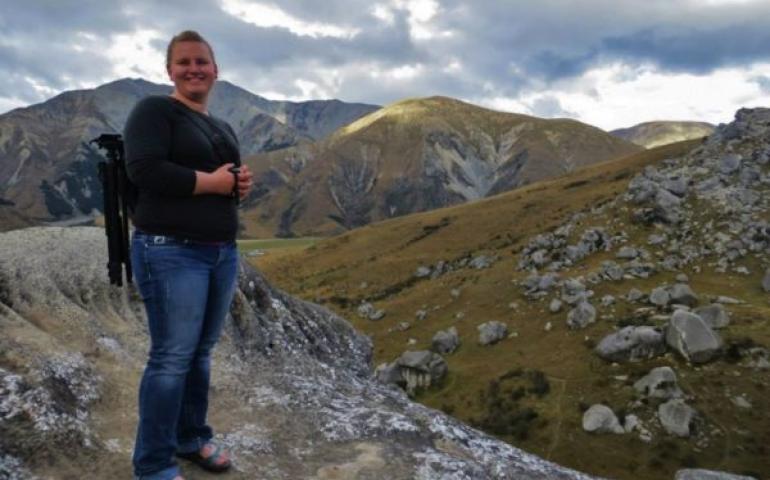
UAF researchers to share ways to boost women in science
December 8, 2017
University of Alaska Fairbanks Geophysical Institute researchers will talk about their efforts to involve girls in science during a panel on...
Read more
Research finds that beavers are colonizing Arctic Alaska
December 7, 2017
Beaver activity in Arctic tundra regions may amplify the effects of climate change on permafrost and lead to landscape changes not currently...
Read more
Researchers to create radar data literacy center
December 1, 2017
University of Alaska Fairbanks researchers will bring radar imagery training to Central and South America. “Over the past two years, the...
Read more
UAF to host drone races
November 27, 2017
The first University of Alaska Fairbanks drone races will be held at the Patty Center ice arena from 11 a.m. to 2 p.m. Sunday, Dec. 3. The Alaska...
Read more
Permafrost tunnel highlighted at Oregon museum’s exhibit
October 26, 2017
A walk-through replica of the U.S. Army Corps of Engineers’ permafrost research tunnel in Fox, Alaska, will be part of a display opening Nov. 3...
Read more
Students fight ice cellar failure
October 17, 2017
Subsistence hunters across the North Slope will soon use computers to monitor temperatures in several ice cellars. The University of Alaska...
Read more
Focus on physics defines Zhang’s career journey
October 4, 2017
Deep inside the University of Alaska Fairbanks’ Geophysical Institute is Hui Zhang’s office. The building’s air ventilation system fills the room...
Read more
New satellite antenna is operational
September 29, 2017
The new blue antenna that sits atop the Elvey Building at the University of Alaska Fairbanks is now operational. The antenna was installed in...
Read more
Geophysical Institute aims research toward defense
September 11, 2017
In an effort to gain more federal funding, the Geophysical Institute at the University of Alaska Fairbanks said it plans to tailor some of its...
Read more
Researchers take on atmospheric effects of Arctic snowmelt
September 6, 2017
Researchers at the University of Alaska Fairbanks’ Geophysical Institute are exploring the changing chemistry of the Arctic’s atmosphere to help...
Read more
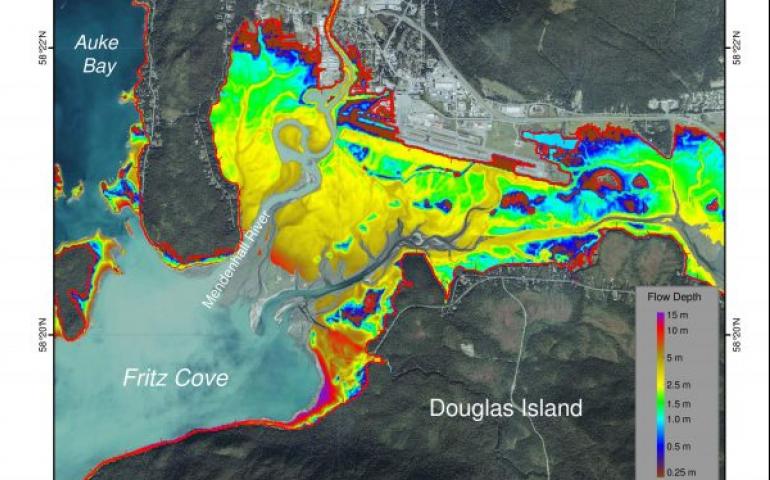
Preparing Alaska’s communities for a tsunami
August 3, 2017
University of Alaska Fairbanks researchers recently gave Juneau and Sitka new information about what ocean waters near these Southeast Alaska...
Read more
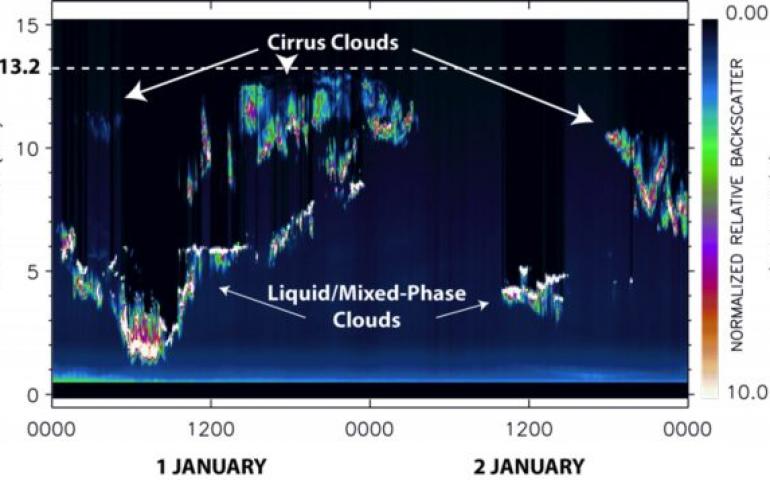
NASA lidar on Elvey Building provides cloud data
August 3, 2017
A rapidly blinking green light beam has been flickering skyward through a foot-square quartz window in the north corner of the roof of the...
Read more
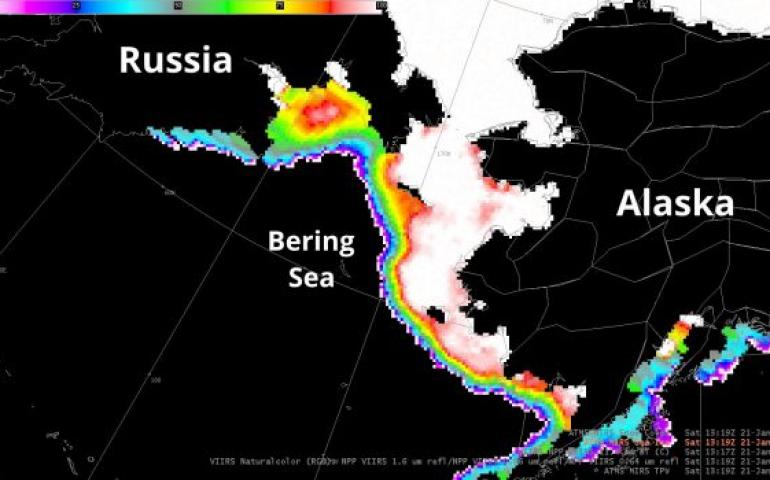
Using microwaves to see through clouds
August 3, 2017
The most common types of satellite images are only able to see the “top” of the sky — if it is a cloudy day, the satellite will only be able to...
Read more
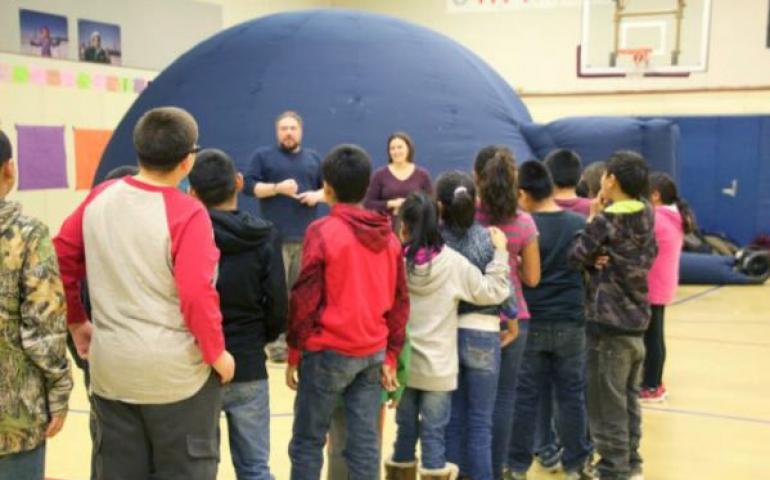
New curriculum connects aurora, Iñupiat culture
January 26, 2017
A new curriculum that weaves aurora science with Iñupiat culture and language is now available for elementary and middle school teachers across...
Read more
NASA sounding rockets to launch from Poker Flat Research Range
January 18, 2017
A NASA sounding rocket campaign starts Jan. 20 and will run through early March at the Poker Flat Research Range in Alaska. The research rockets...
Read more
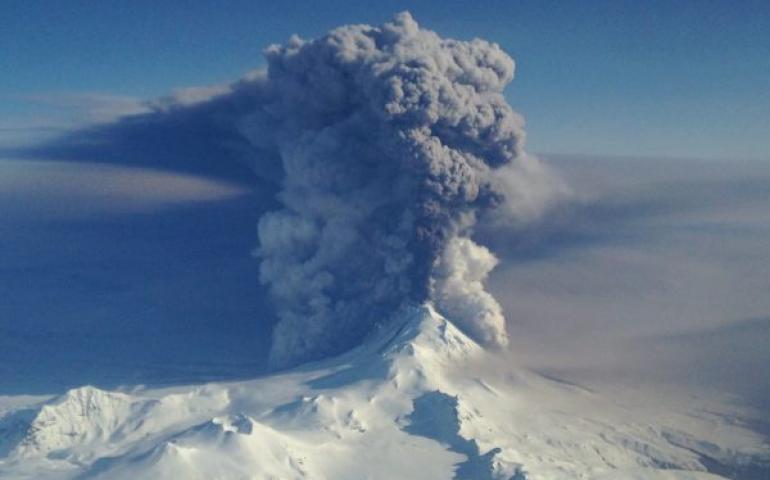
Volcano study examines relationship between seismic signals, sound waves
January 17, 2017
A study of relationships between seismic signals and sound waves from an erupting volcano in Alaska may someday help scientists infer the height...
Read more
UAF researcher joins study of Arctic sea ice change
December 12, 2016
A University of Alaska Fairbanks researcher will participate in sea ice research that combines observations from unmanned aerial systems and...
Read more
Pagination
Previous page
←
Previous
First page
1
Page
21
Page
22
Page
23
Page
24
Current page
25
Page
26
Page
27
Page
28
Page
29
Last page
31
Next page
Next
→