
Kyungmin Kim Ph.D. defense
1 p.m. Sept. 8, Elvey Auditorium
Also available via Zoom
In partial completion of the Ph.D. in Geophysics from the University of Alaska Fairbanks College of Natural Science and Mathematics, Department of Geosciences
Dissertation title: From volcano seismicity to subsurface fluid processes: Integrating physics-based modeling, Bayesian inversion, and laboratory experiments
Abstract: Long-period (LP) seismicity and volcanic tremor are commonly associated with fluid-driven processes in shallow volcanic and hydrothermal systems. However, extracting quantitative information about the underlying dynamics from these seismic signals remains challenging. This dissertation develops an integrated approach combining a physics-based model of LP events and tremor with laboratory experiments, Bayesian inversion, and sequential data assimilation to connect seismic observations with gas-driven pressure oscillations, seismic source properties, and characteristics of the surrounding propagation medium.
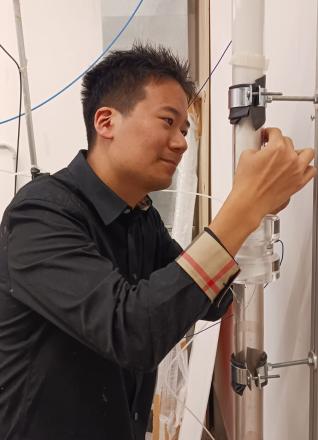
Laboratory experiments provide physical validation of the physics-based model used in this work, demonstrating that gas accumulating beneath permeable media can generate pressure oscillations capable of producing volcanic tremor and LP seismicity. This experimental validation supports the use of the model to quantitatively relate seismic observations to key subsurface properties and dynamics, including gas flow rate, permeability, source geometry, and pressure variations. Building on this foundation, Bayesian inversion is applied to LP events associated with the 2021 explosive and effusive eruptions of Great Sitkin Volcano, Alaska, and to tremor recorded in the Yellowstone Lake hydrothermal system, providing quantitative constraints on source and propagation properties and the underlying gas dynamics.
To extend these analyses from individual seismic observations to the time-dependent evolution of the source, an Ensemble Kalman Filter is developed to assimilate LP event occurrence, amplitude, and spectral characteristics. Applied to Great Sitkin, the method identifies increasing gas flow and maximum-event pressure before the May 2021 explosion, followed by more variable and generally lower gas flow during the effusive phase that began in July 2021. Comparison with satellite gas observations further suggests that declining LP activity may reflect a transition toward aseismic degassing rather than the cessation of gas release.
Together, these results establish a quantitative framework for using volcanic and hydrothermal seismicity to infer the dynamics and physical properties of shallow fluid systems. Beyond retrospective analysis, the methods developed here can be implemented for near-real-time monitoring to track changes in seismic source properties and infer their underlying physical drivers.
Major advisor: Társilo Girona