
New faces at the GI: Veleda A. P. Muller
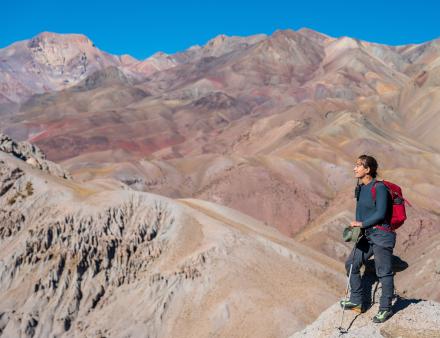
Veleda A. Paiva Muller joined the University of Alaska Fairbanks as a joint Geophysical Institute/College of Natural Sciences and Mathematics appointment in May. She is an assistant professor of neotectonics in the UAF Geosciences Department and a member of the GI Tectonics and Sedimentation group.
She is most interested in mountain building processes and the interactions between the deep Earth and the Earth's surface. She uses a combination of low- and high-temperature thermochronology methods, field structural and stratigraphic data, and numerical modeling to study processes such as crustal thickening, rock uplift and exhumation, and landscape evolution. She expects to be teaching Structural Geology, Tectonics and Field Camp for now, and developing new departmental courses in the future.
Muller notes in the last few years one of her research foci has been on the influence of fluvial and glacial erosion to fold-and-thrust belt development, strain distribution and magma ascent towards the surface.
“I've been working mostly in Cordilleran-type orogenic systems such as the Patagonian and Central Andes, and I am looking forward to starting studying the Alaska accretionary margin and Cordilleran belts,” Muller said. She is interested in adding some thermochronology techniques such as Fission-tracks and (U-Th)/He to the GI.
“I am passionate about mountaineering and rock climbing, I started backpacking in the mountains of the Atlantic forest in Brazil when I was a teenager in the scouts,” Muller said in an email. “That changed my life and I started the geology major to combine my passion for science and the outdoors. In the last 10 years I really got into adventure rock climbing and have climbed in the Andes, Alps and many North American ranges.”
Muller completed her doctorate in Italy and France at the University of Milano-Bicocca and University of Grenoble Alps. She completed a postdoc at the University of Arizona in Tucson, where there are a lot of rocks to both study and climb.
“I think Alaska is a great fit because of its incredible mountain ranges and active tectonic setting. It provides outstanding opportunities to study mountain-building processes while also allowing me to enjoy mountaineering. With the support of the GI, I'm excited to conduct research throughout Alaska and to involve students in my research while inspiring them to explore these fascinating landscapes.”