
Remembering Carl Benson
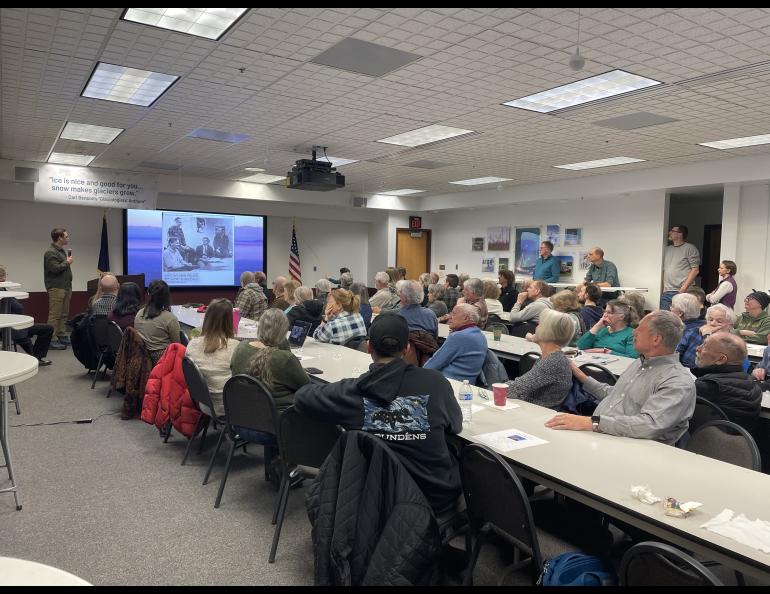
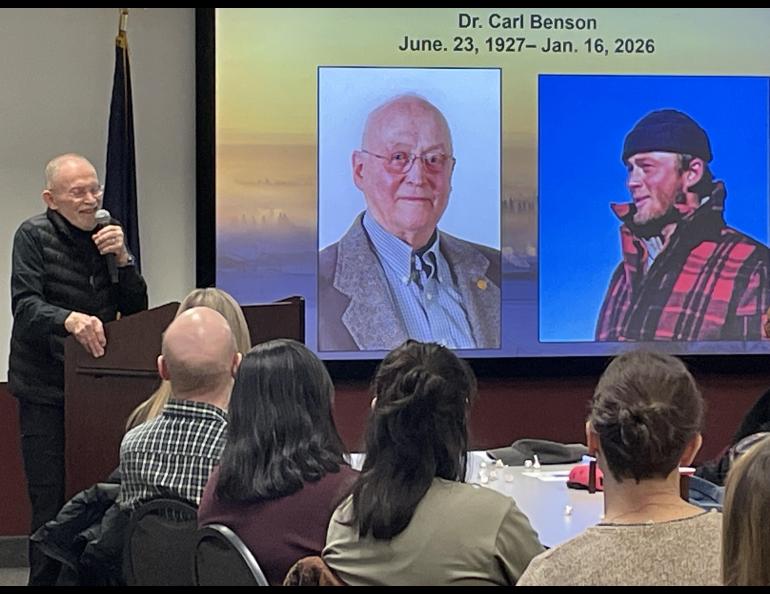
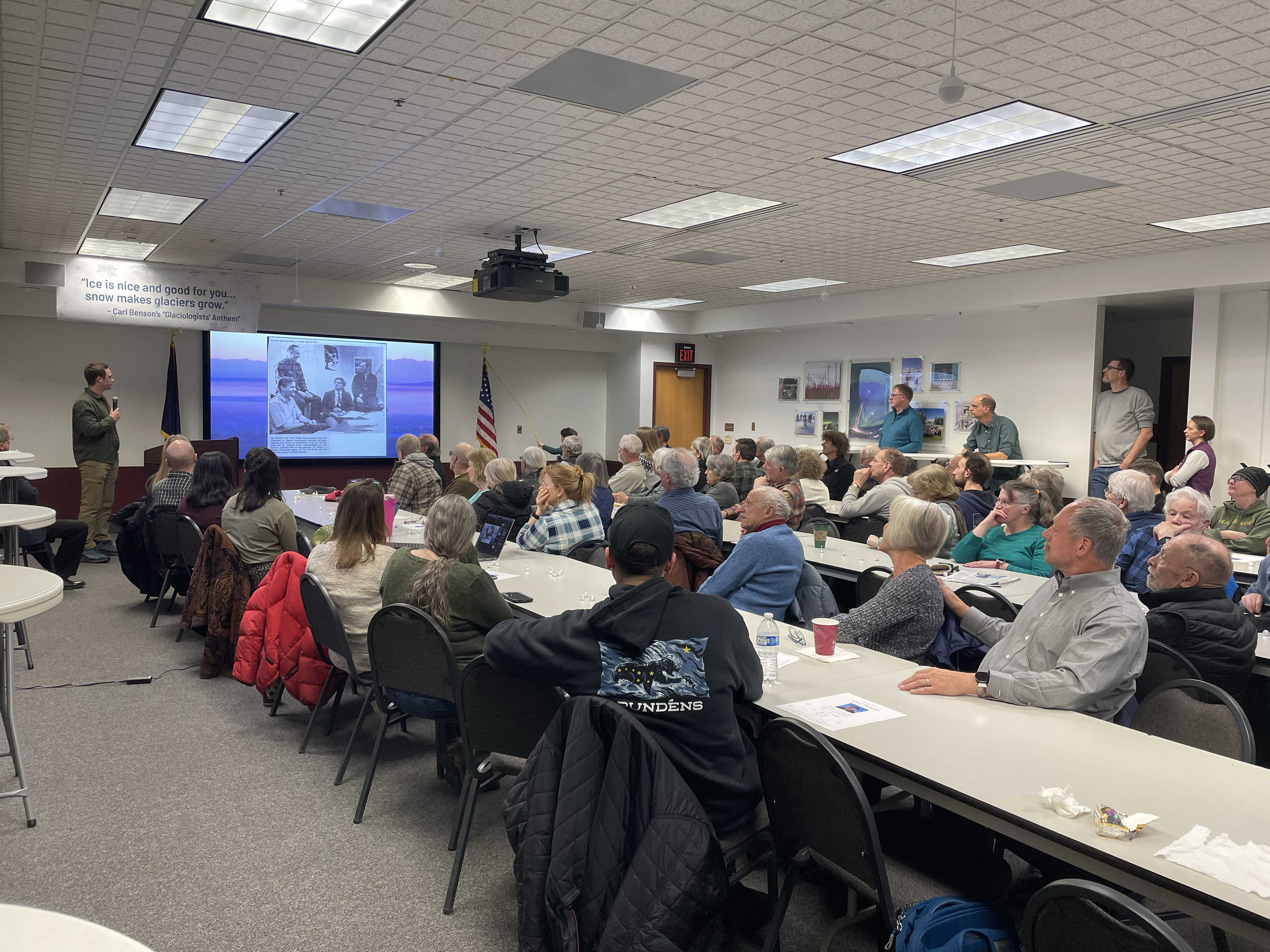
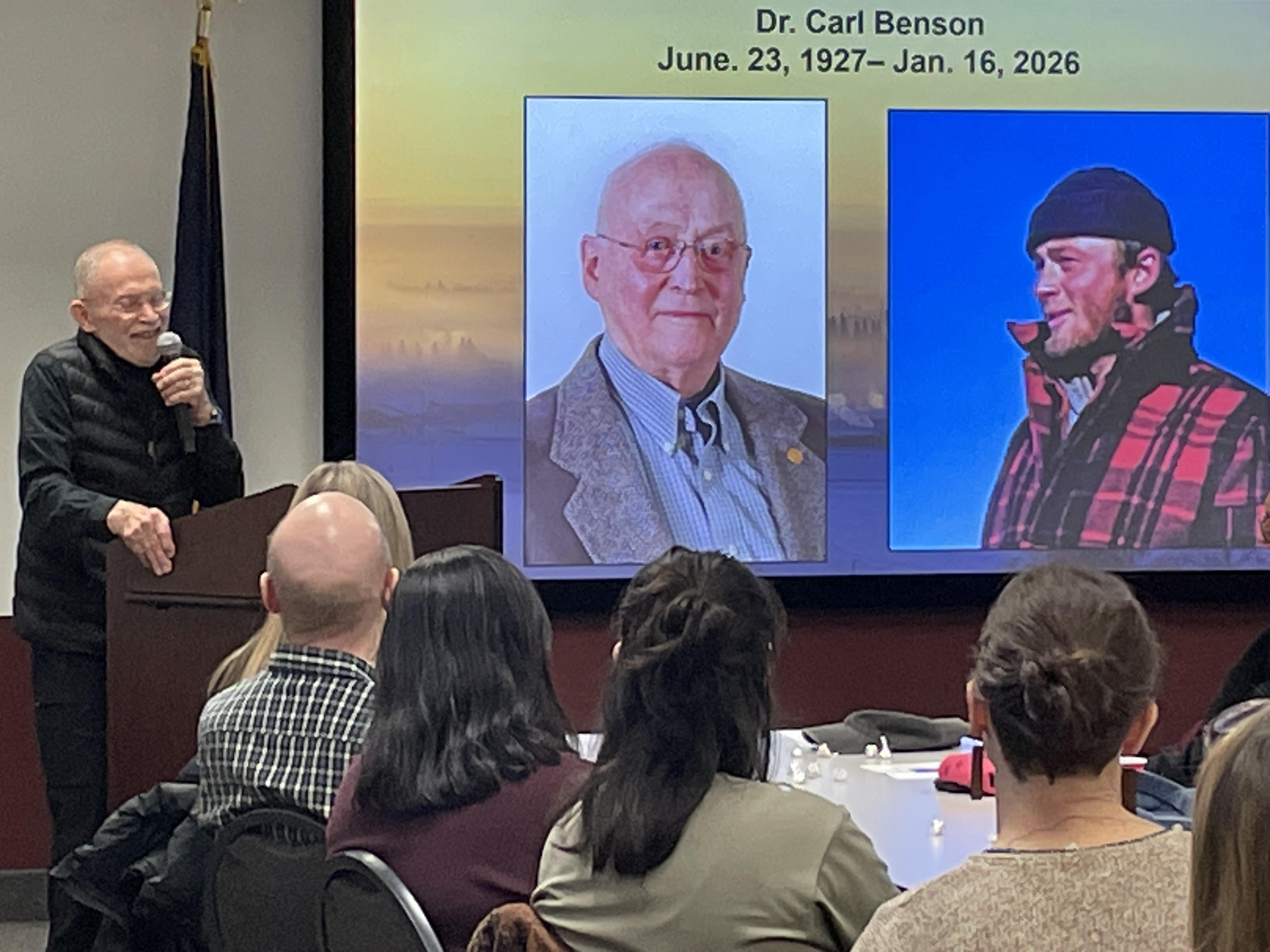
His tribe remembered him fondly at a packed memorial gathering for Carl Benson last Friday. Speakers told multiple stories about his warmth, humor and compassion, as well as his rigor and well-deserved stellar reputation as a scientist.
Speakers included Bob McCoy, Matthew Sturm, Martin Truffer, Ned Rozell and Carl's grandson Isaac Van Flein. Many others shared additional stories and remembrances from the floor.
A large banner hanging in the room spelled out Carl’s “Glaciologists’ Anthem:” “Ice is nice and good for you. Snow makes glaciers grow.”
The GI family extends our warmest condolences to Carl's family and his many friends.
A video recording of the entire memorial gathering is available online.
Last summer, Carl Tape asked Carl Benson about his time in graduate school at Caltech in the 1950s, specifically with seismologists such as Richter and Gutenberg. Here is Carl Benson's response:
=========================
Dear Carl,
You asked me to write about my experience as a graduate student at Caltech and some notes about working with Dr. Charles Richter. It was an exciting time, Dr. Linus Pauling led an attack on atmospheric testing (which gave him his second Non-shared Nobel Prize). You asked about more than just my work with Richter and I have done this. I hope it meets your wishes, and will be glad to talk with you about any shortcomings. I owe a lot to the University of Minnesota so I start there.
In 1946 I got out of the Navy and entered The University of Minnesota as part of the bulge of veterans. I graduated with a BA in 1950 and went North to the Arctic Slope of Alaska to join the USGS in its Reconnaissance studies of Naval Petroleum Reserve #4. I returned in Sept. 1950 to the UofM for graduate studies. I had a graduate assistantship with the Snow Ice and Permafrost Establishment (SIPRE). SIPRE was a unique Laboratory of the U.S. Army, Corps of Engineers Located on the UofM campus. It was dedicated to applying basic research to problems of all aspects of snow, ice, and frozen ground. The organization changed its name, after a merger, to CRREL (Cold Regions, Research and Engineering Laboratories) my part-time appointment turned into a full time job with lots of field work in the arctic and sub-arctic of northern Canada, Labrador, and Greenland. It lasted for six years and that is when I got married, and entered Caltech in January 1956 with a project in mind for my dissertation.
While at Caltech, I had a graduate assistantship. It was mostly with Dr. Robert P. Sharp but included others: Dr. Hewit Dix and Dr, Charles Richter. For one or two quarters, I was an assistant to Dr. Richter. My job was to draw circles, using the difference between the P minus S arrival times to determine the radius from recording stations and pick the intersection points to locate the epicenters. We often had more than three or four recording stations so the epicenter locations were accurate. Some time we worked late and Charlie would go to the coffee stand and pour cold coffee into his cup and savor the flavor. I asked him about that and he said it was just as good hot or cold. He told me that if you find an epicenter on the San Andreas Fault, it’s an error. He was convinced that an earthquake on the San Andreas would be such a major event that everyone would know. He had a remarkable memory that shows in his book. I think these comments may tell you a little about Richter’s book. I was pleased to have it and when I asked him to sign it for me, he went all shy and reached for the book and wrote his name in it. He was shy and read Russian authors, in their original Russian. He told me the Russian novels were written in a rich language that made a difference. He knew people considered him to be eccentric and he didn’t let it bother him.
There were highlights such as special lectures by Egon Orowan, and R. A. Bagnold. I remember one incident when Orowan made a special lecture on a day of heavy Pasadena rain. Beno Guttenberg was in the audience and after the lecture Orowan said: “Professor Guttenberg, to have your presence in my lecture, on a rainy day like this, is worth more to me than any medal I might receive.”
There were many interesting things going on at Caltech then, as am sure there are today. I made many friends that have lasted a lifetime. Among my closest friends were fellow graduate students Jack Healy, Don Anderson, Lisle Jory, Al Sanford and their wives. Don Anderson and I wrote a paper, expanding the theory of densification that I had developed in Chapter VI, of my Dissertation, to other sediments in addition to snow. I also had a good relation with Sam Epstein, he taught me about using the stable isotopes of Oxygen. My dissertation includes a calibration of using stable isotopes to determine annual units in snow exposed in the walls of hand dug pits in Greenland.
The Caltech YMCA was unique, it had no swimming pool, but it sponsored leadership lecture programs. The leader that they brought lived in one of the student dorms for a few days and ran seminars and special lectures and had bag lunch on campus. They had experts from industry and political leaders. One of these was Dr. Martin Luther King. He came during the time Black Americans were Boycotting the bus system in Selma, Alabama. He gave several special talks and was a genuine leader during those turbulent days. Ruth and I enjoyed talking with him. The man behind the “Y” and its programs was Wes Hershey.
Caltech is an amazing place. I had trouble keeping up in some classes in Physics, I would walk into a class that I had done the prerequisites for at least six years ago. That was difficult, especially since my classmates had taken the prerequisites a few months ago, but I did it. In addition, I had a SIPRE Report to finish, in addition to writing my dissertation which was published by SIPRE. Also, Ruth and I had our first child at Caltech. Ruth had been working as a visiting Nurse with the Red Feather organization which covered a large region of Pasadena, Altadena, Riverside, etc. It was a busy bit of time for us. Ruth died on 25 July, last year, I miss her terribly. In my aged and weakened self today, I couldn’t do all I did then.
Apologies for being Late, and Best Wishes to you and your interest in fundamental science that looks ahead, but does not ignore the exciting Past.
Carl S. Benson