
Planet_Walk_Mercury.mp3
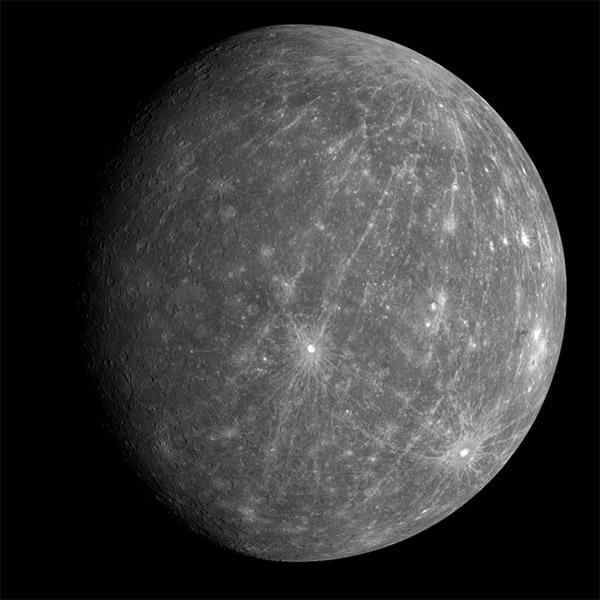
Mercury has no moons and no rings. Most of its surface would appear greyish-brown to the human eye. Mercury's surface resembles that of Earth's moon, scarred by many impact craters resulting from collisions with meteoroids and comets.
The bright streaks extending from Mercury’s craters are called "crater rays." They are formed when an asteroid or comet strikes the surface. The tremendous amount of energy that is released in such an impact digs a big hole in the ground, and also crushes a huge amount of rock under the point of impact. Some of this crushed material is thrown far from the crater and then falls to the surface, forming the rays. Fine particles of crushed rock are more reflective than large pieces, so the rays look brighter. The space environment—dust impacts and solar-wind particles—causes the rays to darken with time.
Facts about Mercury:
Mercury is covered by a massive network of fault lines that originated when the planet cooled, and shrank, shortly after it was formed. Water ice is believed to exist in craters near Mercury's poles, where it would be in constant shadow and never melt.
Like our moon, Mercury is airless. Because of this, and how close it is to the sun, Mercury has the greatest day-night temperature difference of all the rocky planets (425˚C to -180˚C).
Mercury statistics:
-
Distance from the sun: 57 million km (35 million mi)
-
Diameter: 0.383 x Earth
-
Mass: 0.0553 x Earth
-
Time for one full orbit ("year"): 88 Earth days
-
Time for one full rotation ("day"): 4,222.6 Earth hours
-
Smallest and fastest moving planet in the solar system