
Planet_Walk_Venus.mp3
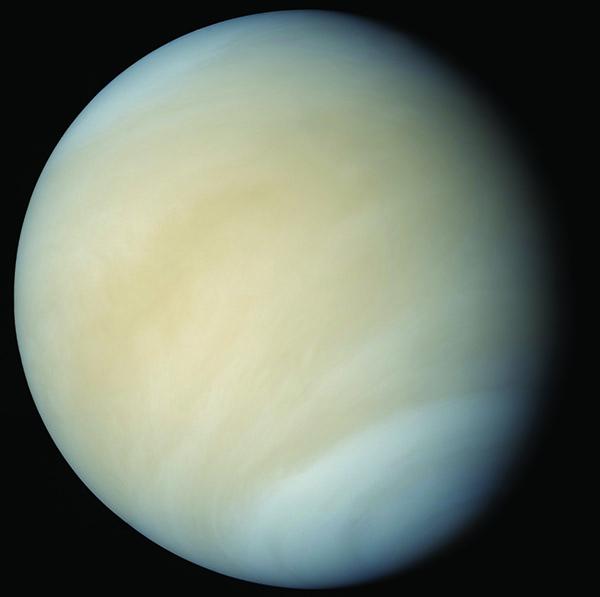
Because it’s the brightest object in the sky (except for the sun and moon) Venus can be seen from Earth without a telescope. Venus has no magnetic field.
Venus is sometimes referred to as Earth’s sister planet because of similarities: they are both about the same size (Venus being slightly smaller), their densities and chemical compositions are similar, and both have few craters which indicates their surfaces are relatively “young.”
Facts about Venus:
Venus is the hottest planet in the solar system, with surface temperatures hot enough to melt lead, zinc, tin, and several other metals. It can reach temperatures of 462° C (864° F), about twice as hot as a typical household oven.
Extreme heat is trapped within Venus's atmosphere by a thick layer composed of carbon dioxide and clouds of sulfuric acid.
Venus has no moons and no rings.
Venus statistics:
-
Distance from the sun: 108 million km (67 million mi)
-
Diameter: 0.95 x Earth
-
Mass: 0.815 x Earth
-
Time for one full orbit ("year"): 225 Earth days
-
Time for one full rotation ("day"): 2,802 Earth hours
-
Rotates clockwise, the opposite of Earth