
Planet_Walk_Saturn_0.mp3
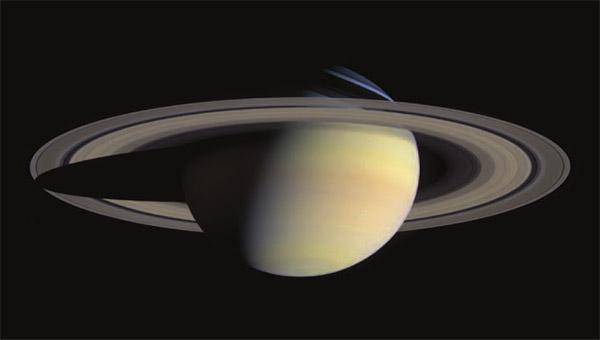
Saturn is the second largest planet in our solar system, after Jupiter. Saturn’s beautiful rings are one of the most intriguing aspects of this planet. Saturn's rings are thought to be pieces of comets, asteroids or shattered moons that broke up before they reached the planet, torn apart by Saturn's powerful gravity. They are made of billions of small chunks of ice and rock coated with another material such as dust. The ring particles mostly range from tiny, dust-sized icy grains to chunks as big as a house.
Twice every 29.5 years Saturn appears ringless. This is an optical illusion: Earthlings cannot see Saturn’s rings when the rings are edge-on as viewed from the Earth. They are barely visible through powerful telescopes.
Facts about Saturn:
Saturn is a massive planet surrounded by an outer layer of gases mostly made up of hydrogen and helium. A six-sided jet stream has been observed on Saturn's north pole.
Saturn is well-known for its visible rings mostly made of ice, dust, and rocks. The rings are about 400,000 km (240,000 mi) wide, the approximate distance from Earth to the moon.
Saturn has 62 moons, 53 have been confirmed and nine are still being studied.
Saturn statistics:
-
Distance from the sun: 1.5 billion km (934 million mi)
-
Diameter: 9.45 x Earth
-
Mass: 95.2 x Earth
-
Time for one full orbit ("year"): 29.4 Earth years
-
Time for one full rotation ("day"): 10.7 Earth hours
-
Average density: Less dense than water