
Planet_Walk_Neptune.mp3
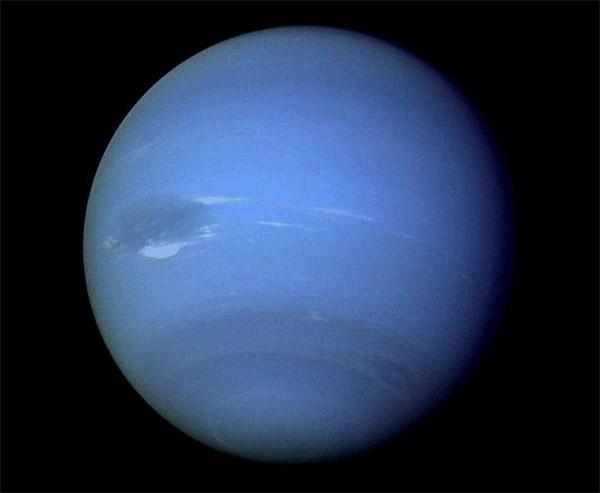
Neptune's blue color is largely the result of absorption of red light by methane in the atmosphere, but there is some additional as-yet-unidentified factor which helps give the clouds their rich blue tint.
Like Jupiter and Saturn, Neptune has an internal heat source -- it radiates more than twice as much energy as it receives from the sun.
Facts about Neptune:
Neptune is an ice giant. It is the only planet in the solar system that cannot be seen with the naked eye. Its windy atmosphere is made up primarily of hydrogen, helium, and methane.
Neptune has 13 confirmed moons and six faint rings. Neptune's largest moon, Triton, is the only large moon in the solar system that orbits its planet in the opposite direction from the planet’s rotation.
Neptune statistics:
-
Distance from the sun: 4.5 billion km (2.8 billion mi)
-
Diameter: 3.88 x Earth
-
Mass: 17.1 x Earth
-
Time for one full orbit ("year"): 165 Earth years
-
Time for one full rotation ("day"): 16 Earth hours
-
Solar system's windiest planet