
Planet_Walk_Pluto.mp3
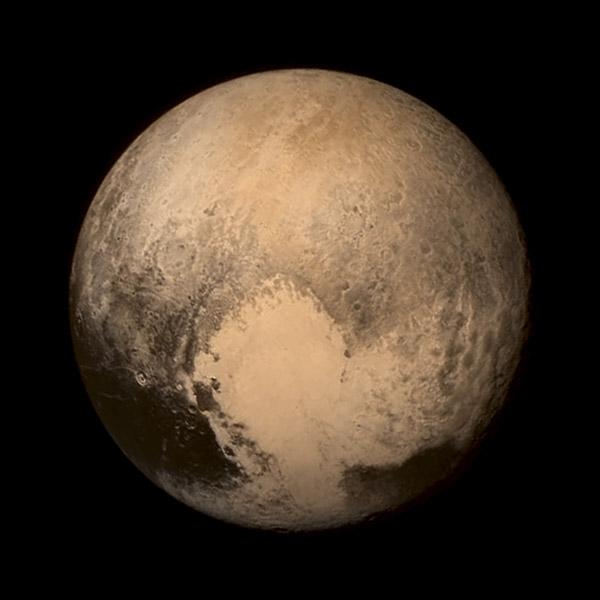
Pluto—which is smaller than earth’s moon—has a heart-shaped glacier the size of Texas and Oklahoma. This fascinating world has blue skies, spinning moons, mountains as high as the Rockies, and it snows—but the snow is red.
Facts about Pluto:
Pluto is no longer considered a planet. Pluto is considered a dwarf planet, a category that includes Makemake, Haumea, and Eris.
Pluto has five moons. Its largest moon, Charon, is so big that Pluto and Charon orbit each other like a double planet.
Pluto is located in the Kuiper Belt, an area of space scientists are just beginning to study. The Kuiper Belt is a donut-shaped region of icy objects beyond the orbit of Neptune.
Pluto statistics:
-
Distance from the sun: 5.91 billion km (3.67 billion mi)
-
Diameter: 0.186 x Earth
-
Mass: 0.0025 x Earth
-
Time for one full orbit ("year"): 248 Earth years
-
Time for one full rotation ("day"): 153.3 Earth hours
-
Reclassified as a dwarf planet in 2006