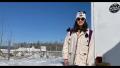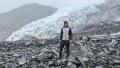
Meet graduate student researcher Gabrielle Nowak
Graduate student researchers are the future of science and an integral part of our UAF Geophysical Institute family.
So let’s meet another one of them.
Here’s Gabrielle “Gabby” Nowak from the GI’s Space Physics Group. Her advisor is assistant professor Doğacan Ozturk.
Q: Where are you from? Tell us about that place.
Gabby: I’m originally from West Michigan. I grew up in Grand Haven, which is a small beach town on the shore of Lake Michigan.
Q: Tell us about your education path. Where were you before coming to UAF? What stage are you at in your graduate program?
Gabby:I attended Central Michigan University as an undergrad, where I majored in physics with an astronomy concentration and minored in mathematics and computer science. As a first-generation college student, I was a part of the McNair Scholars Program and had the opportunity to participate in research studying the spectra of Be-type star disks. As a graduate student at UAF, I changed gears from astronomy to space physics. I am currently a Ph.D. candidate.
Q: Tell us about your general field of research. What do you find interesting about it?
Gabby: A major subset of space physics work has to do with investigating Earth’s magnetic field and its interaction with the solar wind. Space weather can impact aspects of everyday life – from communications, GPS navigation and power outages to aurora forecasting. This is what I found most exciting about space physics and encouraged my decision to transition from astronomy. The work still feels exploratory and large-scale but is also more tangible and human-focused.
Q: What are you working on now?
Gabby: The topic I study is called interhemispheric asymmetry. This has to do with differences in the ways space weather manifests between the northern and southern hemispheres of Earth. At large scales, the magnetic field of Earth is like that of a bar magnet, which is dipole shaped with magnetic field lines connecting the northern and southern hemisphere. There are a number of reasons space weather might look different between hemispheres, however. Using magnetometers at the footpoints of the same magnetic field line in both hemispheres, we can develop a better sense of how space weather might manifest between hemispheres under variable conditions.
Q: Why did you choose UAF?
Gabby: I was initially attracted to UAF because of the location. I’ve always enjoyed winter sports, and Fairbanks is a prime location for cross-country skiing. Speaking with some of the physics graduate students is what cemented my decision, however. Thanks to discussions with graduate students over Zoom and email, I was able to get a sense of the university and department culture, which helped me decide that UAF was a good fit for me.
Q: What do you like most about doing research at the UAF Geophysical Institute?
Gabby: I appreciate being in close proximity to so much cool science. Via seminars or quick elevator chats, doing research at the Geophysical Institute has provided me with many opportunities to learn about the work being done in other areas of geoscience.
Q: What do you do outside of UAF? What would you tell someone about things to do in Fairbanks?
Gabby: I enjoy running outdoors and spending time with my dogs, Onyx and Opal. There are many extensive trail systems within Fairbanks. If I were to recommend something to do in town, I would suggest sampling some of the trails with a short walk, run or ski.
Q: What do you hope do be doing when you complete your graduate degree?
Gabby: I can see myself following a number of different paths, but regardless of where I end up, I hope to be working with people – perhaps through teaching or science outreach.
Q: Anything else you’d like to add?
Gabby: Thanks for giving me the opportunity to share a bit about myself! I really enjoy the work that I do and the community I have here at UAF.
Rod Boyce, University of Alaska Fairbanks Geophysical Institute, 907-474-7185, rcboyce@alaska.edu
Mark Fahnestock, University of Alaska Fairbanks Geophysical Institute, 907-687-6371, mfahnestock@alaska.edu