

Alaska climate report: A quiet June … except for all that lightning
June was mostly a meteorologically mild month across Alaska, with temperatures near or slightly below normal. Precipitation was below average in many areas, particularly in western Alaska.
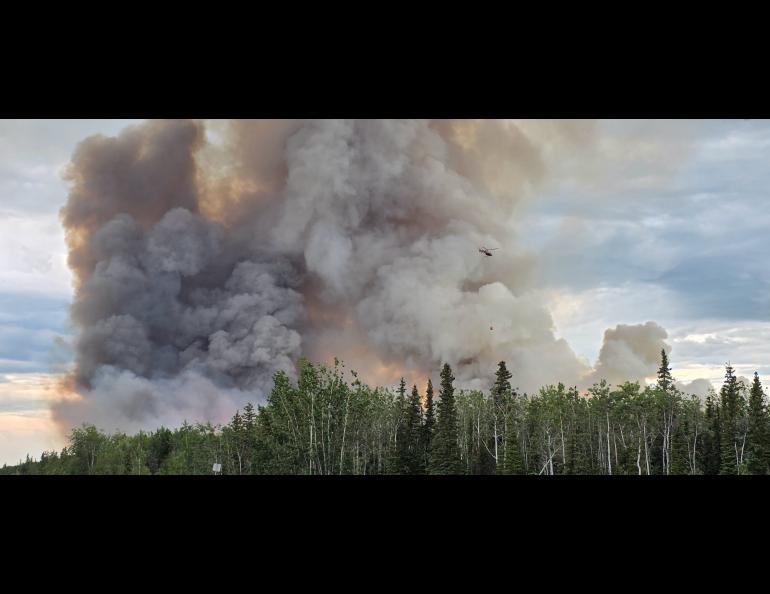
Fire activity increased during the second half of the month after lightning ignited several blazes, though the overall fire season continued its slow start.
Arctic sea ice remained at or near record-low levels throughout the month.
The Alaska Climate Research Center issued its June climate summary earlier this month. The climate center is part of the University of Alaska Fairbanks Geophysical Institute.
“June was a relatively quiet month overall, but it was one that featured several important climate indicators rather than headline-grabbing extremes,” said ACRC Director Martin Stuefer, who is also the Alaska state climatologist.
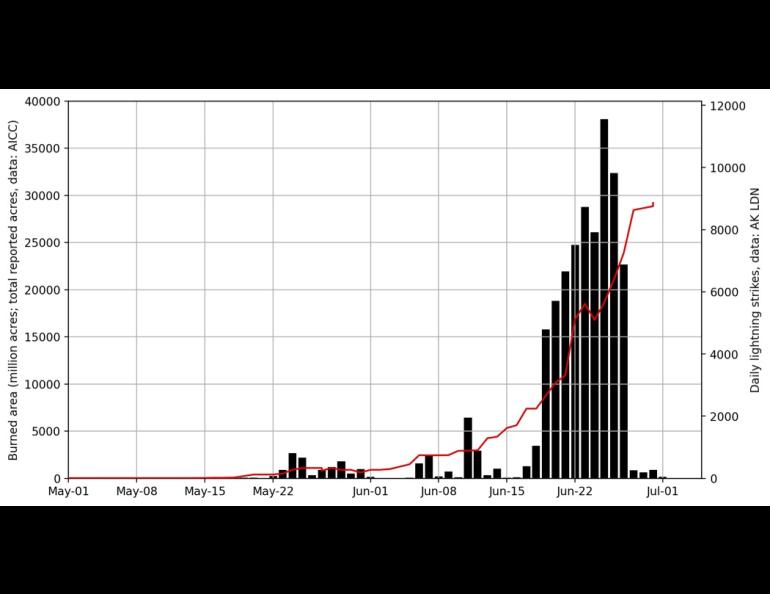
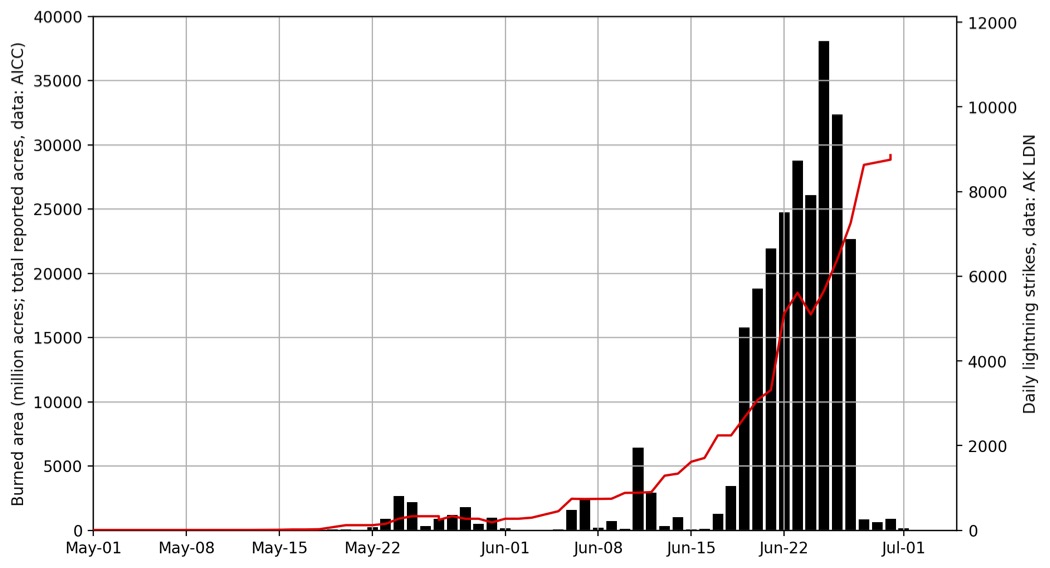
The 2026 fire season remained slow to start, but a sharp increase in lightning from June 19-25 in northern Alaska ignited several fires. Red flag warnings were issued in several areas, including around Delta Junction, the Yukon Flats, Talkeetna, Anchorage, the Upper Kobuk Valley and the Lower Koyukuk Valley.
Daily lightning strikes climbed from 21 on June 16 to 242 on June 17 and 415 on June 18, then surged to 4,246 on June 19 and 4,356 on June 20. The total then soared to 5,135 on June 21, 6,156 on June 22, 7,357 on June 23 and 7,434 on June 24.
The number skyrocketed to 9,264 strikes on June 25.
“Fortunately, cooler conditions and a late-month cold front prevented what could have become a much more significant fire outbreak,” Stuefer said.
A blast of cold Arctic air reached northern and Interior Alaska during the second week of June, with higher elevations in the Brooks Range seeing some late-season snow. Low-pressure returned to the Gulf of Alaska around the same time, sending a series of storm systems into southern coastal areas in mid-month. Heavy rain was reported in Kodiak and parts of the Panhandle.
Heavy rain from the same system prompted flood advisories for the Middle Fork of the Koyukuk River and along the Dalton Highway from Coldfoot to Atigun Pass.
Daily temperatures showed a mix of slightly warmer-than-normal and cooler-than-normal conditions.
The strongest warm-temperature records in June were led by Kodiak, where the temperature reached 77 degrees on June 5, topping the previous record of 70 degrees set in 1980. Kodiak also set a daily high temperature record of 78 degrees on June 4, breaking the record of 77 degrees set in 2022.
Other new daily high temperature records were set June 3 at Nome, where the temperature reached 72 degrees, topping the 70-degree record from 1993, and Yakutat, where the temperature reached 79 degrees, surpassing the 78-degree record from 1997.
June also saw a few new daily low temperature records. Kodiak recorded a low of 36 degrees on June 25, breaking the previous record low of 39 degrees set in 2009. Bettles set a daily low temperature record of 29 degrees on June 9, below the previous record of 31 degrees set in 2016, and Utqiaġvik set a daily low temperature record of 24 degrees on June 28, breaking the 26-degree record set in 1921
Other June highlights:
• June precipitation was below average across much of Alaska. Western Alaska was particularly dry, with only 27% of normal precipitation recorded at Kotzebue and Cold Bay and 46% at Bethel. Approximately 7% of the state was classified as abnormally dry as of June 23. The affected area extended across the Seward Peninsula and the Kotzebue Sound region northward toward Point Hope.
• Total Arctic sea ice extent again remained at or near record low levels throughout June. As in previous months, below-average ice conditions in Eastern Canada and the European Arctic accounted for much of the overall Arctic sea ice deficit. Eastern Greenland was also noticeably below average. In Alaska waters, ice was mostly gone from the Bering Sea. The time of melt was similar to recent years despite the near-record regional low winter extent.
• Martin Stuefer, University of Alaska Fairbanks Geophysical Institute, mstuefer@alaska.edu
• Rod Boyce, University of Alaska Fairbanks Geophysical Institute, 907-474-7185, rcboyce@alaska.edu


