Meet graduate student researcher Audrianna ‘Ozzy' Schneider
Graduate student researchers are the future of science and an integral part of our UAF Geophysical Institute family.
So let’s meet another one of them.
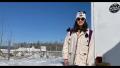
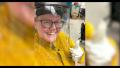
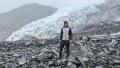
Here’s Audrianna "Ozzy" Schneider of the GI’s Volcanology Group. Ozzy’s advisor is professor Jessica Larsen.
Q: Where are you from? Tell us about that place.
Ozzy: I grew up in Geneseo, Illinois, a small town full of charm and friendly faces… it's home, even if it’s missing one key feature: volcanoes!
Q: Tell us about your education path. Where were you before coming to UAF? What stage are you at in your graduate program?
Ozzy: I completed a double-major B.A. in Creative Writing and Geology at Augustana College in Rock Island, Illinois. What began as an interest in scientific journalism shifted after hands-on research in the Caribbean, where I studied igneous texture growth through cooling experiments and discovered a love for volcanology. This led me to enthusiastically Google ‘Top 10 Colleges to Study Volcanoes in the U.S.,’ which is how I found UAF. As a graduate student here, I've moved from igneous and experimental petrology into volcanology, allowing me to expand my laboratory skill set and explore my research interests further. I am now a master’s student working on a fascinating project at Mount Churchill in Alaska.
Q: Tell us about your general field of research. What do you find interesting about it?
Ozzy: My research broadly falls within volcanology, with a focus on understanding magma storage and volatile budgets. While institutions such as our Alaska Volcano Observatory (AVO) actively monitor many volcanoes in Alaska, not all systems—such as Mount Churchill—can be continuously observed. This makes reconstructing volcanic processes through geological and geochemical records especially important. What I find most compelling about this work is that volcanology constantly reminds us how much there is still to learn; despite advances in monitoring and modeling, each volcano preserves only part of the story. That ongoing uncertainty is what draws me to the field and motivates my research.
Q: What are you working on now?
Ozzy: I am currently developing a new method to study melt inclusions in more silica-rich volcanic eruptions. Melt inclusions are tiny pockets of molten rock that become trapped inside growing crystals as magma cools beneath a volcano. Because they act like natural time capsules, melt inclusions preserve information about magma composition, temperature, and dissolved gases from deep within the Earth—details that are often lost once an eruption occurs. My work focuses on expanding melt inclusion research to more silicic systems, which are traditionally more difficult to study. This approach will help improve our understanding of the understudied Mount Churchill in Alaska, and it will also provide future researchers with tools to investigate volcanoes that lack commonly studied minerals such as olivine or pyroxene. By broadening the types of volcanic systems we can analyze, this method has the potential to deepen our understanding of how volcanoes behave, even when direct monitoring is not possible.
Q: Why did you choose UAF?
Ozzy: I was interested in UAF for a number of reasons—the location, the Geophysical Institute, and the way alumni spoke so fondly about their time here. After conversations with Dr. Jessica Larsen about possible research directions, it quickly became clear that this was where I belonged.
Q: What do you like most about doing research at the UAF Geophysical Institute?
Ozzy: What I like most about doing research at the UAF Geophysical Institute is the sense of community—being surrounded by passionate researchers and sharing in the excitement of new discoveries and successful experiments.
Q: What do you do outside of UAF? What would you tell someone about things to do in Fairbanks?
Ozzy: In my downtime, I’m often curled up on the couch with my cat, Nova, a good book, and a few rocks or craft projects scattered nearby. I also enjoy exploring—whether that’s heading out to nearby outcrops or just strolling around town and admiring the natural beauty that makes Fairbanks so special. When family and friends visit, I always insist they check out the Museum of the North at UAF and experience as much of Alaska’s incredible scenery as they can.
Q: What do you hope to be doing when you complete your graduate degree?
Ozzy: When I complete my graduate degree, I hope to work toward becoming a geology professor specializing in volcanology. I am drawn to positions that allow me to spend time in the laboratory, collaborate with others, and teach students. I especially enjoy hands-on lab work and the opportunity to help others learn new concepts, which motivates my long-term career goals.
Q: Anything else you’d like to add?
Ozzy: Thank you for this opportunity! I’ve really enjoyed sharing a bit about my interests—I genuinely love what I do and the community here at UAF.
• Rod Boyce, University of Alaska Fairbanks Geophysical Institute, 907-474-7185, rcboyce@alaska.edu