

Fairbanks’ winter air isn’t as stagnant as it seems
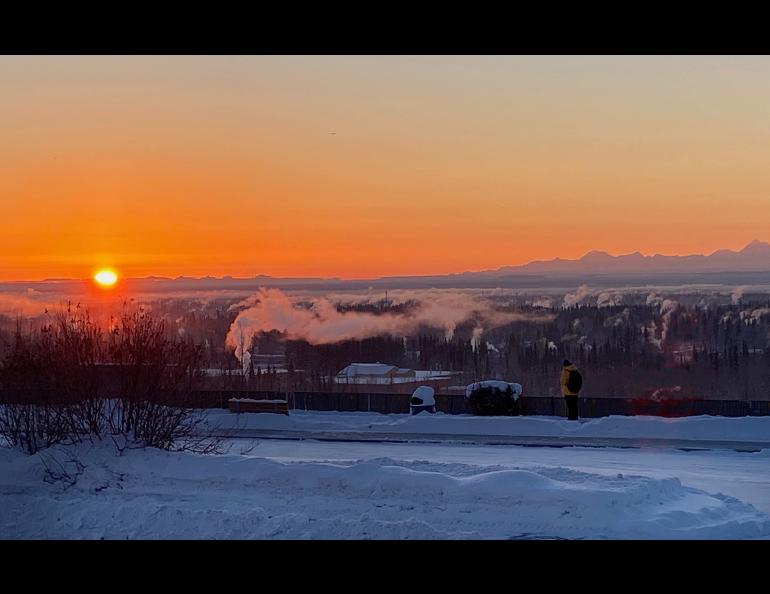
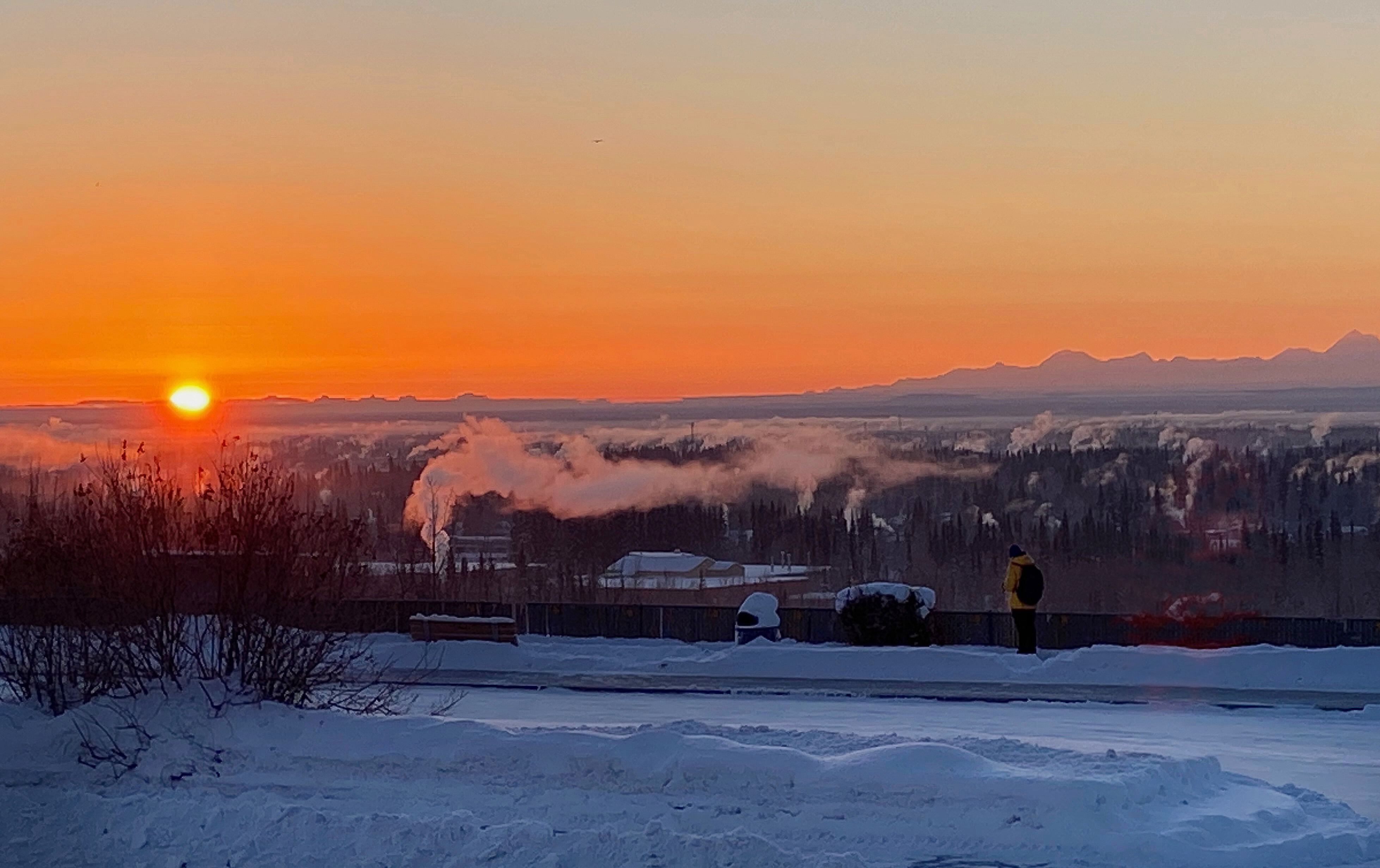
Fairbanks’ stinky wintertime air isn’t as stagnant as people think. Polluted air continues to move through the city even during severe temperature inversions, with fresh emissions continually replacing older pollution, according to new research.
The problem is that inversions slow the movement of air, allowing pollution to build up faster than it can escape.
“The air is actually going out of Fairbanks, but new cleaner air is also entering Fairbanks,” said University of Alaska Fairbanks professor William Simpson, an atmospheric and environmental chemist who co-authored a research paper providing new insight about the city’s wintertime air.
“New pollution is being emitted into the air, and that is what you are breathing,” he said. “The bad smell you smell was really emitted just a couple hours ago.”
Simpson is affiliated with the UAF Geophysical Institute and the UAF College of Natural Science and Mathematics.
The findings could help air quality officials decide which pollution sources to target and how best to reduce emissions.
Knowing how quickly air moves through Fairbanks will help officials understand two types of pollution. Primary pollutants come directly from sources such as wood stoves and vehicles. Secondary pollutants form when chemicals react in the atmosphere.
“For pollution control strategies, you need to know whether the pollutant you’re interested in is directly emitted or forming in the atmosphere,” Simpson said.
The work was published in July in Environmental Science & Technology. Meeta Cesler-Maloney, a recent UAF doctoral graduate, adapted the computer model used to study how pollution moves through the air in Fairbanks. Jonas Kuhn led the paper’s writing during his time at the University of California, Los Angeles.
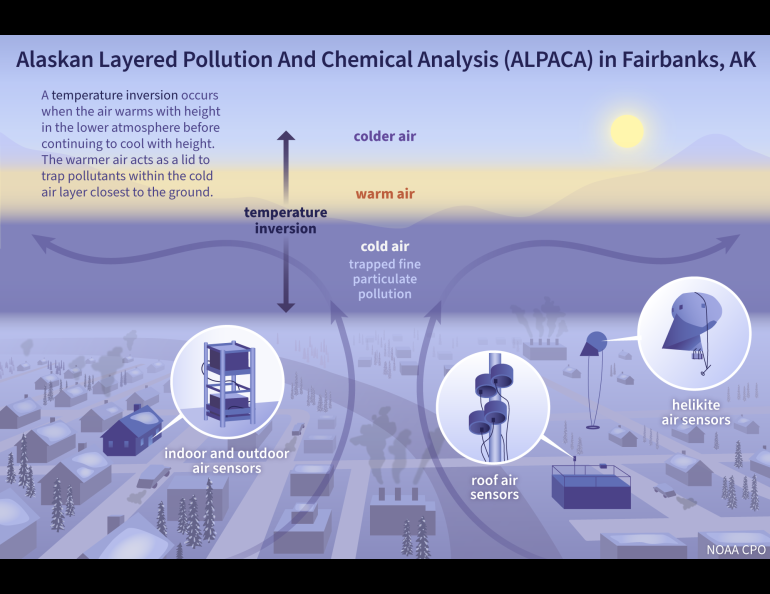
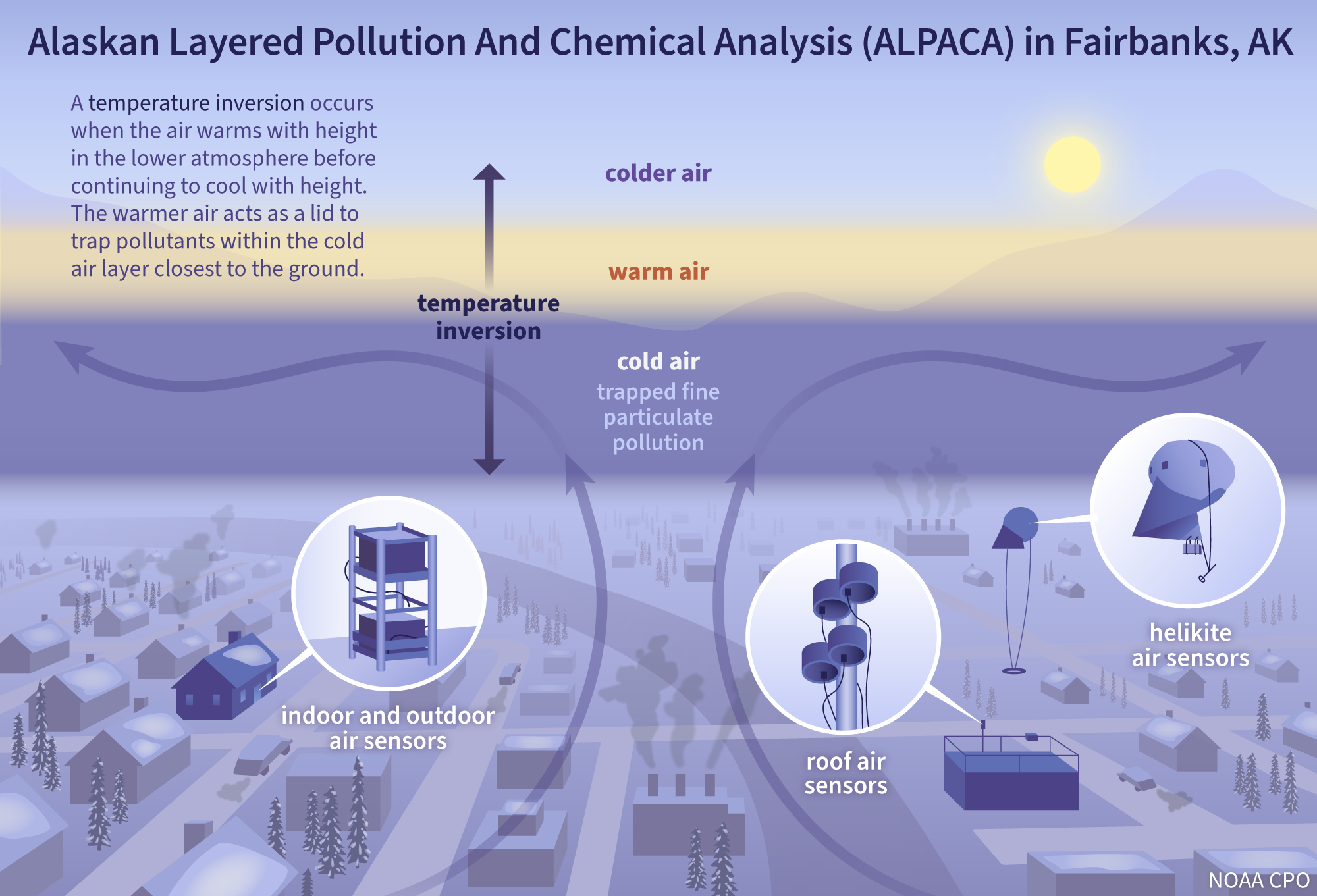
The research was part of the 2022 Alaskan Layered Pollution and Chemical Analysis project, or ALPACA. Nearly 50 scientists from the U.S. and Europe spent seven weeks in Fairbanks in early 2022. They studied how pollution behaves in cold, dark conditions and how layers of air affect pollution levels.
ALPACA was funded by the National Science Foundation, the National Oceanic and Atmospheric Administration and European sources. The project is part of an international air quality effort called Pollution in the Arctic: Climate Environment and Societies and was conducted in collaboration with local, state and federal air quality agencies.
To date, ALPACA has resulted in 32 papers in the peer-reviewed literature, with more expected.
A temperature inversion occurs when warmer air sits above colder air near the ground, trapping pollution close to the surface. This exposes people to higher levels of tiny airborne particles, known as PM2.5, and gases such as sulfur dioxide and nitrogen oxides.
Simpson compares Fairbanks to a bathtub. Water represents pollution flowing into the tub, while the drain represents air carrying pollution out of Fairbanks. On a windy day without an inversion, the drain is wide open.
“An inversion slows the outflow, like a clog in the drain,” he said. “Then the pollution builds up because it’s still being emitted faster than it can be flushed away.”
The researchers wanted to learn how air movement and chemical reactions affect pollution levels in Fairbanks. They studied three pollutants that form through chemical reactions in the air: nitrate, secondary sulfate and hydroxymethanesulfonate.
Computer modeling showed that air typically stayed in the shallow polluted layer near the ground for just 30 minutes to 3 1/2 hours before being replaced by cleaner air. The researchers studied a five-day period of heavy pollution.
This steady exchange of air affects both the amount and type of pollution in Fairbanks.
Some pollutants leave the area before they can react with other chemicals to form new pollutants. However, the movement of air can also help sustain the chemical reactions that produce secondary sulfate and hydroxymethanesulfonate, adding to the pollution.
The findings show why air quality officials must consider both pollution released directly into the air and pollution that forms through chemical reactions.
“A short residence time means you’re going to have more problems from the primary emissions and not as much problem from the secondary processes because there wasn’t enough time to form them,” Simpson said.
Even the slow movement of air during an inversion helps prevent pollution from reaching even higher levels, Simpson said.
Simpson said the new research is important for Fairbanks residents to understand.
“It’s really hard for air to stay somewhere,” he said. “There’s always a little breeze that’s pushing it around.”
• William Simpson, University of Alaska Fairbanks, wrsimpson@alaska.edu
• Rod Boyce, University of Alaska Fairbanks Geophysical Institute, 907-474-7185, rcboyce@alaska.edu


