
NASA chief explores UAF's space places
NASA Administrator Jared “Rook” Isaacman visited the University of Alaska Fairbanks Monday, with stops at an Alaska Space Grant Science Fair, the Babula Planetarium at the University of Alaska Museum of the North and the NASA-funded Alaska Satellite Facility antenna on top of the Elvey Building. He held a chilly hibernating Arctic ground squirrel, had an in-depth tour of Poker Flat Research Range and took questions from the media. At a well-attended town hall with students in Schaible Auditorium, Isaacman touched on the future of space exploration, innovation, technology and the opportunities available to the next generation before taking questions from the audience. This event was part of NASA’s “Inspiration Tour” to celebrate the nation's strengths in space exploration and aeronautics.
View the official…
read more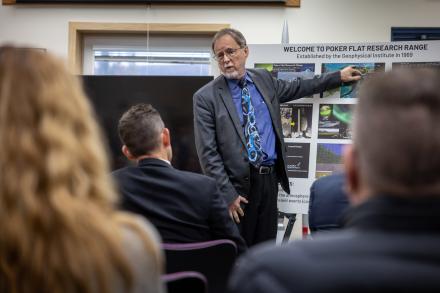
Visit the Byte Machine for a quick bite!
Did you know there’s a new vending machine in the hallway between Elvey and West Ridge Research Building where you can buy freshly made sandwiches, desserts, snacks and beverages? It's called a Byte Machine, and was installed by UAF Dining Services’ contractor Chartwells just a couple weeks ago.
You can use your debit or credit card, or Bear Bucks credit on your PolarExpress card, to purchase items in the Byte machine, but it won’t accept cash. All items put into the machines have an RFID tag attached. The machine has little cameras that scan the shelves after the door is closed and use that to determine how much to actually charge for each transaction. However, pay attention, because if you pick something up and look at it to read the ingredients or whatever, and you put it back with the RFID chip facing down, the machine will charge you for that item!
“We will definitely keep that machine (in the Elvey-WRRB hallway) well-stocked; it…
read more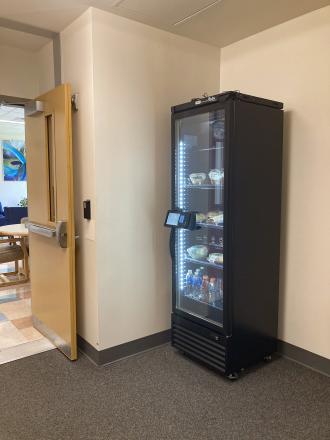
Congratulations, 2026 graduates and honorees!
Congratulations, UAF graduates, and here's to your next adventure! We've created a photo gallery to celebrate our Geophysical Institute-affiliated graduates and honorees. You've been such an integral part of the GI's accomplishments and research, we can't wait to see the great things you'll do.
More information is available online about UAF's 105th Commencement, including a profile of the Class of 2026 listing the names of all graduates, prize winners, speakers, honorary degree recipients and faculty receiving emeritus status.
Congratulations to Don Hampton of the Space Physics and Aeronomy group and Ned Rozell, GI science writer and author of the Alaska Science Forum column, for being honored with emeritus status at the Gold Ceremony, Friday, May 1, 2026.
Congratulations also to ALL of the GI graduates! Here are the names and advisors for all the doctoral graduates…
read more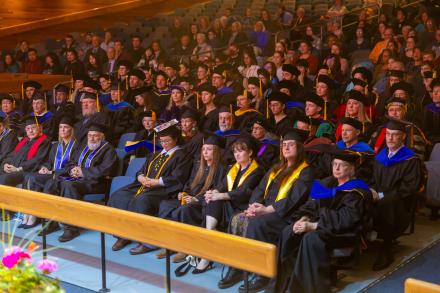
Earth System Science Symposium shares student research
The 2026 UAF Earth System Science Symposium brought together more than a hundred participants on Saturday, Feb. 28 — students, faculty members and others — to review undergraduate and graduate student posters about their research projects.
“Now in its second year, the symposium is becoming the cornerstone student research symposium on campus, open to all students and offering free poster printing, free food and networking opportunities in addition to the main professional opportunity to present research and soak in others' research,” said Carl Tape, who served as one of the event organizers.
Broadly, Earth system science is the application of systems science to study the interconnected components of Earth — the atmosphere, hydrosphere, lithosphere, cryosphere and biosphere — and how they interact to produce an integrated whole. At UAF the ESS program offers masters and doctoral degrees and involves faculty…
read more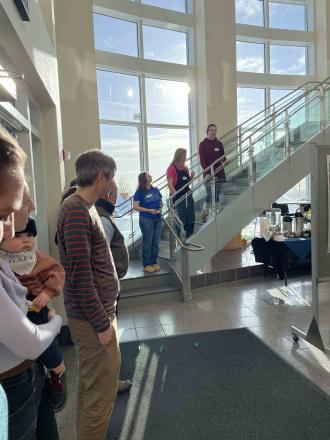
Remembering Carl Benson
His tribe remembered him fondly at a packed memorial gathering for Carl Benson last Friday. Speakers told multiple stories about his warmth, humor and compassion, as well as his rigor and well-deserved stellar reputation as a scientist.
Speakers included Bob McCoy, Matthew Sturm, Martin Truffer, Ned Rozell and Carl's grandson Isaac Van Flein. Many others shared additional stories and remembrances from the floor.
A large banner hanging in the room spelled out Carl’s “Glaciologists’ Anthem:” “Ice is nice and good for you. Snow makes glaciers grow.”
The GI family extends our warmest condolences to Carl's family and his many friends.
A video recording of the entire memorial gathering is available online.
Last summer, Carl Tape asked Carl Benson about his time in graduate school at Caltech in the 1950s, specifically with seismologists such as Richter and Gutenberg…
read more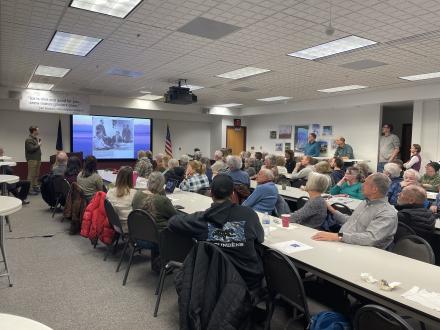
Remembering Carl Benson
GI Faculty, Staff and Students:
With a heavy heart I have to report that a giant of the Geophysical Institute, Carl Benson, died on Friday, January 16. He was 98.
Carl has been a stalwart of the Snow, Ice and Permafrost Group at the GI since coming to UAF in 1960. His research both before and after coming to Fairbanks took him on expeditions to many far-flung parts of the North Slope, Arctic Canada and Greenland, where he gathered data that’s still stimulating research. His contributions at the GI, where he arrived a year after statehood to teach and conduct research, leave a significant mark on the institute and on the university.
In 2012, Carl was the first recipient of the Roger Smith Lifetime Achievement Award, granted annually to a faculty member who shows “sustained commitment” to the Geophysical Institute. He continued to conduct research and publish after retiring as Professor of Geophysics and Geology, Emeritus in 1987. Just last month Matthew Sturm and…
read more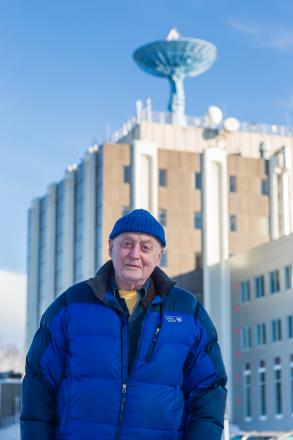
Elvey parking lot block heaters: Please park in the right spot!
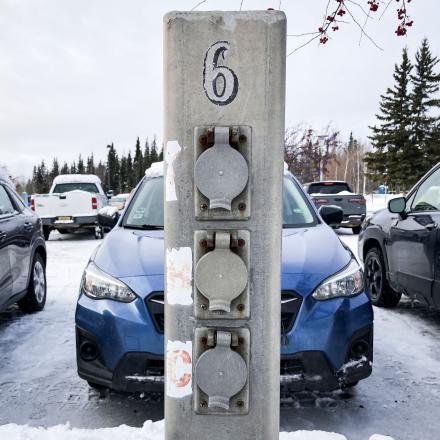
Brrr, it's cold outside and rapidly getting colder! If you drive to work you're probably going to be plugging in your car. Here is more information about how the block heater outlets work on campus. Use the block heater outlets as a guide for parking:
- The block heater outlets in front of Elvey and Akasofu in lot 9B can accommodate three vehicles on each side; one car should park directly in front of the post, and then one to the immediate right or left so that everyone's electric cords can reach an outlet.
- When parking behind Elvey/WRRB/Akasofu in lots 9S or 9E, and some outlets directly in front of Akasofu in lot 9B, please park to the immediate right or left of the outlet post in front of your vehicle because they are…
Fifth HAARP Open House is one for the books
More than 300 visitors came through the gates of HAARP, the High-frequency Active Auroral Research Program, on June 14 as part of the fifth public open house hosted by the facility since it became part of the University of Alaska Fairbanks Geophysical Institute in 2015. That meant the open house was also celebrating the 10th anniversary of the GI being in charge of this world-class research instrument!
Participants could tour the HAARP array and generator room, talk to a graduate student who runs the array during HAARP research campaigns, listen to scientist lectures about HAARP and the aurora, visit the drone petting zoo or run a drone flight simulator hosted by the Alaska Center for Unmanned Aircraft Systems Integration, buy tacos from local food truck vendor Ernesto's from Glenallen, enjoy special HAARP or GI cookies, or maybe even purchase a little HAARP merch. Each of the six programs…
read more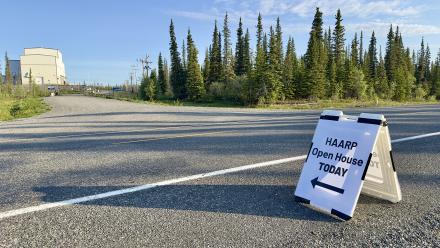
Congratulations, 2025 graduates and honorees!
Congratulations, UAF graduates, and here's to your next adventure! We've created a photo gallery to celebrate our Geophysical Institute-affiliated graduates and honorees. You've been such an integral part of the GI's accomplishments and research, we can't wait to see the great things you'll do!
More information is available online about UAF's 103nd Commencement, including a profile of the Class of 2025 listing the names of all graduates, prize winners, speakers, honorary degree recipients and faculty receiving emeritus status.
Congratulations to…
read more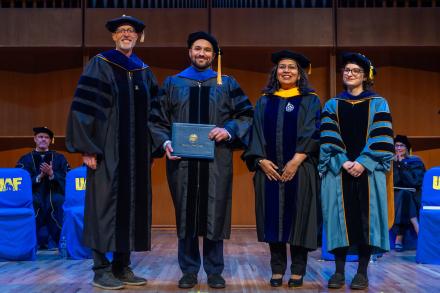
UAF educator to join Earth science and education program team
by Rod Boyce
Christina Buffington will serve as deputy director for training, education and public engagement at the Implementation Office of GLOBE, the Global Learning and Observations to Benefit the Environment program.
Buffington is science education director and program manager with the Geographic Information Network of Alaska, a unit of the University of Alaska Fairbanks Geophysical Institute.
GLOBE is a science and education program implemented in 127 countries. Participants in GLOBE include citizen scientists (students and non-students), educators and scientists who contribute environmental observations to enable advancements in science and applications as well as long-term environmental monitoring.
… read more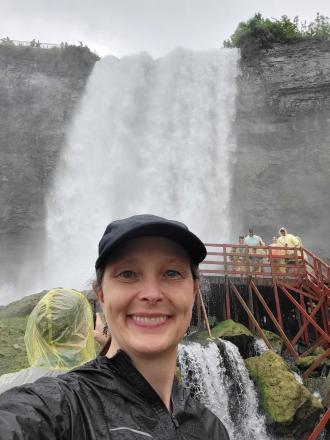
Bringing a conference booth to life
The UAF booth at the annual American Geophysical Union Fall Meeting is the result of many hours’ work by many people.
Planning each year starts literally as soon as last year’s conference ends, when a reservation is made for next year’s booth space. Booth planners make decisions about how much space the booth will need, where it will be located in the exhibit hall and, later in the year, what furniture needs to be rented from the exhibit contractor.
Those planning decisions are led by the booth manager — for the last several years Kelly Eagan of GI Communications has held that post. She works closely with many others, including GI Communications Director Becky Lindsey, Communications Coordinator Sara Wilbur, and representatives of other UAF units that support and help staff the booth.
AGU planning committee meetings take place at regular intervals, beginning roughly six months before the conference. Participants include representatives of university units…
read more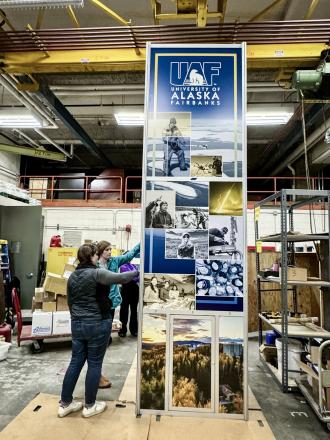
First Friday event at West Ridge well-received
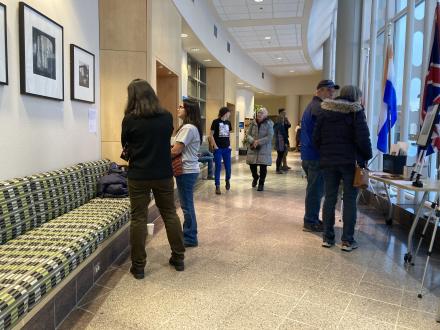
Art, culture, literature and music were on the bill for the First Friday event last week in the main hall of the Akasofu Building. The turnout was excellent, with attendees coming from other offices on campus as well as the greater Fairbanks community.
Participants included JR Ancheta, Alice Bailey, Kyra Bornong, Cierra Childs, Holly Dean, LJ Evans, Klara Maisch, Nicole Mölders, Chip Morris, Carolyn Parcheta, Tobey-Jean Priest, Ned Rozell, John Smelter, Rawser Spicer, Matthew Sturm, Ken Tape, Maggie Harings and Matt Vonlintig. North Star Strings performed in the Akasofu lobby.
Particular kudos are due Tohru Saito of the International Arctic Research Center for organizing the event. ACUASI also kept their doors open and invited visitors in to learn about their program.
Welcome to a new semester!
Welcome to a new academic year, especially to new faculty, staff and students who are joining us!
I am constantly impressed by the hard work and dedication I see daily from the members of the GI.
Over the past four months we have seen successful field research campaigns, hosted our largest and very well received PARS summer school, and met and toured state legislators and other visitors who are looking to partner and work with us — the list goes on. The behind-the-scenes support of the Business Office, Design Services, Proposal Office, Education Outreach, Human Resources, Operations, and Public Relations, all lend themselves to the efforts of the GI faculty, GI Centers and Operational programs. Daily I see the work that all of you do as the reason for the GI's success and I thank you all.
Thank you again for all your hard work and I look forward to seeing you around the GI!
Poker Potluck Pig Roast: Thank yous and photos
Despite a gray day and intermittent rain, lots of Geophysical Institute folks showed up for the 2024 Poker Potluck Pig Roast last Friday.
Many, many thanks to so many people who helped make this event a success! First of all to Tracy and Bill Durnan for tending the roasting pig all night so it was tender and juicy for the next day's feast. Also many thanks to Kathe Rich, Dave Hill and Tony Tyree of Poker Flat Research Range for hosting this terrific all-GI event, and to Operations staff Tracy Piechoci, Grady Baumfalk and Alex Beer for a whole host of things they helped with.
Also many thanks to Mike Roddewig, Vishnu Kumar and Satyaki Das for presenting tours and demos of the Lidar Observatory; Don Hampton and Jason Ahrns for tours of the Davis Science Center; Sara Wilbur, Kelly Eagan and Becky Lindsey of GI Communications for organizing the details; and to Crytal Ruerup of the Director's Office for assistance above and beyond the call of duty. Thank you all!
… read more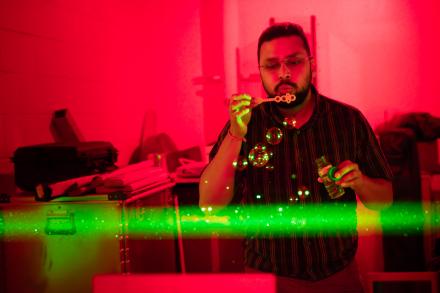
Multicolored spirals a different way of envisioning space weather data
Mark Conde, professor of space physics at the University of Alaska Fairbanks Geophysical Institute, wanted something easier to use for the analysis of solar activity data. And something easier on his eyes would also be good.
So he created multicolored data spirals. Strip away their data labels, and the spirals could hang as wall art.
“The reason I decided to try plotting the space weather data in a spiral form is that the widely-used alternative format — the so-called "Bartels musical diagram" — stacks the solar rotations vertically, with discontinuities when the (arbitrarily defined) rotations begin and end,” Conde said.
Take a look at a Bartels diagram. You’ll think for a moment you are looking at a musical score and easily understand why scientists refer to it as the "Bartels musical diagram.”
Above are examples of a Bartels diagram and one of Conde’s diagrams. These “Condegrams” are easy to use and easy on the eyes.
“When I first…
read more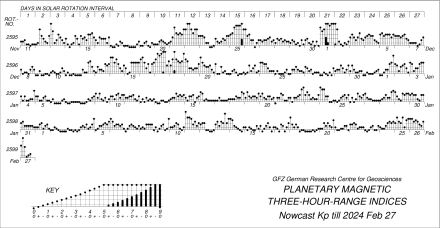
Remembering Chris Fallen
Former Geophysical Institute colleague Chris Fallen died at his home in Albuquerque, New Mexico, earlier this month.
Fallen’s more than 14-year affiliation with UAF and the Geophysical Institute began when he came to Fairbanks as a doctoral student in 2004 after completing a Master of Arts in mathematics at the University of Kansas and Bachelor of Science at Fort Lewis College in Colorado. He completed a Ph.D. in space physics at UAF in 2010, working with Professor Brenton Watkins as his adviser.
As a graduate student, Fallen worked at the Arctic Region Supercomputing Center at UAF, where he conducted computational research on projects for Watkins. After graduation he eventually was promoted to research associate professor of space engineering physics at ARSC, where he remained until 2015 when his position moved to the Geophysical Institute. From March 2018 to March 2019 Fallen was chief scientist at HAARP.
During his time at UAF, Fallen was active in…
read more DSCF0938.JPG (2.86 MB)
Thanks for Thanksgiving!
Dear GI Faculty, Staff and Students:
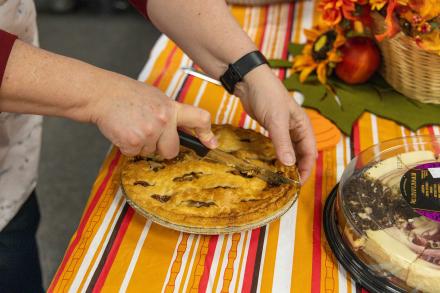
Thank you again for a terrific and very successful GI Thanksgiving. It was great to see so many people together enjoying an excellent meal. Thanks for all the excellent cooking, all the food, and I wish all of you a very happy Thanksgiving. Special thanks go out to all those who helped plan and execute this event:
The set-up team:
Cheryl Petersen, Cletta Schaeffer, Dani Innes, Katie Best, Loreta Thomas, Rita Murphy, Corri Conkle, Oliver Halvarson, Soumitra Sahkalkar and Christy Pena
The turkey/ham/potato/stuffing & coffee chefs
Laura Conner, Jessica Larsen, Lillian Anderson-Misel, Wade Albright, Suzy Nicolai, Cheryl Petersen, Cletta Schaeffer, Dani Innes, Katie Best, Loreta Thomas, Rita Murphy, Donna Evans, Anna Brumbelow, Jess Ramos, Lily Berrey, Collen Morey, Katie Herkstroeter and Corri Conkle
And the Carvers
Wade Albright, Soumitra Sahkalkar,…
GI aurora forecast a hit at Chiang Mai University
The GI Public Information office received a particularly interesting email last week.
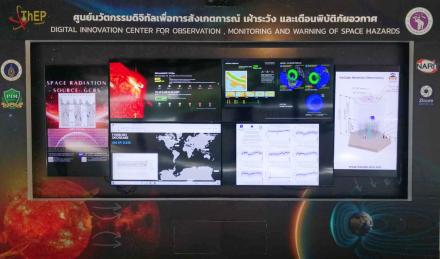
“I am Suwicha Wannawichian, a faculty member from Chiang Mai University, Thailand. I am working on the auroral analysis corresponding to the magnetospheric data for my research. To introduce our research field to the general public, we would like to share your aurora forecast from the…
The Peekskill meteor
On Oct. 9, 1992, a great meteor, visible from Kentucky to New York, was observed as a fragmenting fireball crossing the sky at 7:50 p.m. EDT. It crashed into a 1980 Chevrolet Malibu owned by 18-year-old Michelle Knapp of Wells Street in Peekskill, NY.
The stone meteor was discovered under the car, still warm and smelling of sulfur. It had a mass of 12.37 kilograms and was later determined to consist of chondrite, Olivine-Bronzite and brecciated. It was characterized as an H6, or an ordinary chondrite from the H group that is petrologic type 6, according to the Meteoritical Society website.
The Peekskill meteorite offered a rare and unique window for scientific investigation largely due to the film and video footage of its descent. Video cameras trained on Friday night high-school football games turned skyward to capture the rocketing fireball. As a result, several scientific investigations were…
read more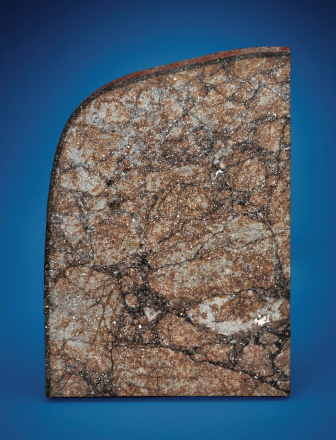
Celebrating GI grad students
Geophysical Institute graduate student researchers are the future of science. We want to celebrate them as much as we celebrate the accomplishments of our veteran researchers, so the GI Communications Department has begun an occasional story+video series to highlight some of our young scientists.
We now have four of these wonderful students on the GI’s website home page, with the video+story of glaciologist Amy Jenson added just last week.
We hope to produce a story and video package every six weeks or so through the near future, with the aim of representing the various GI disciplines and its diversity.
Watch the videos and read the stories. When you do, you’ll find the future of science will be in great hands.
Meet Ph.D. student Valerie Wasser
…
read more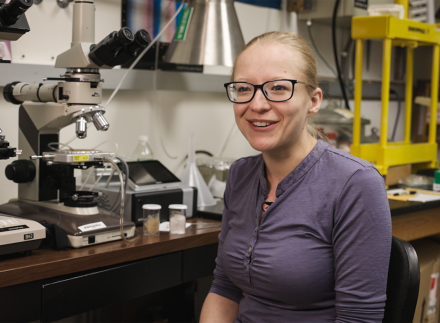
Rare earth elements and critical minerals topic of public meeting
Geophysical Institute labs and personnel were a part of a UAF-hosted public meeting about carbon ore, rare earth elements and critical minerals earlier this month.
Assistant professor Sean Regan, director of the GI’s Geochronology Lab, and Martin Stuefer, director of the GI’s Hyperspectral Imaging Lab, participated in a panel titled “Expanding the University of Alaska’s Capabilities to Support Alaska’s REE/CM Industry.”
…
read more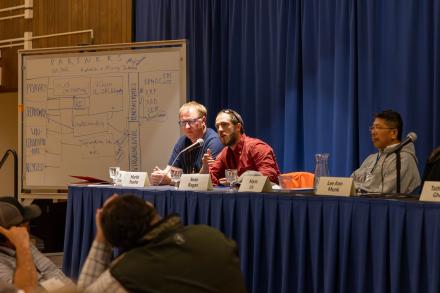
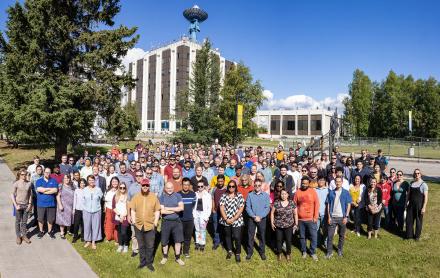
2023 All-GI group photo available
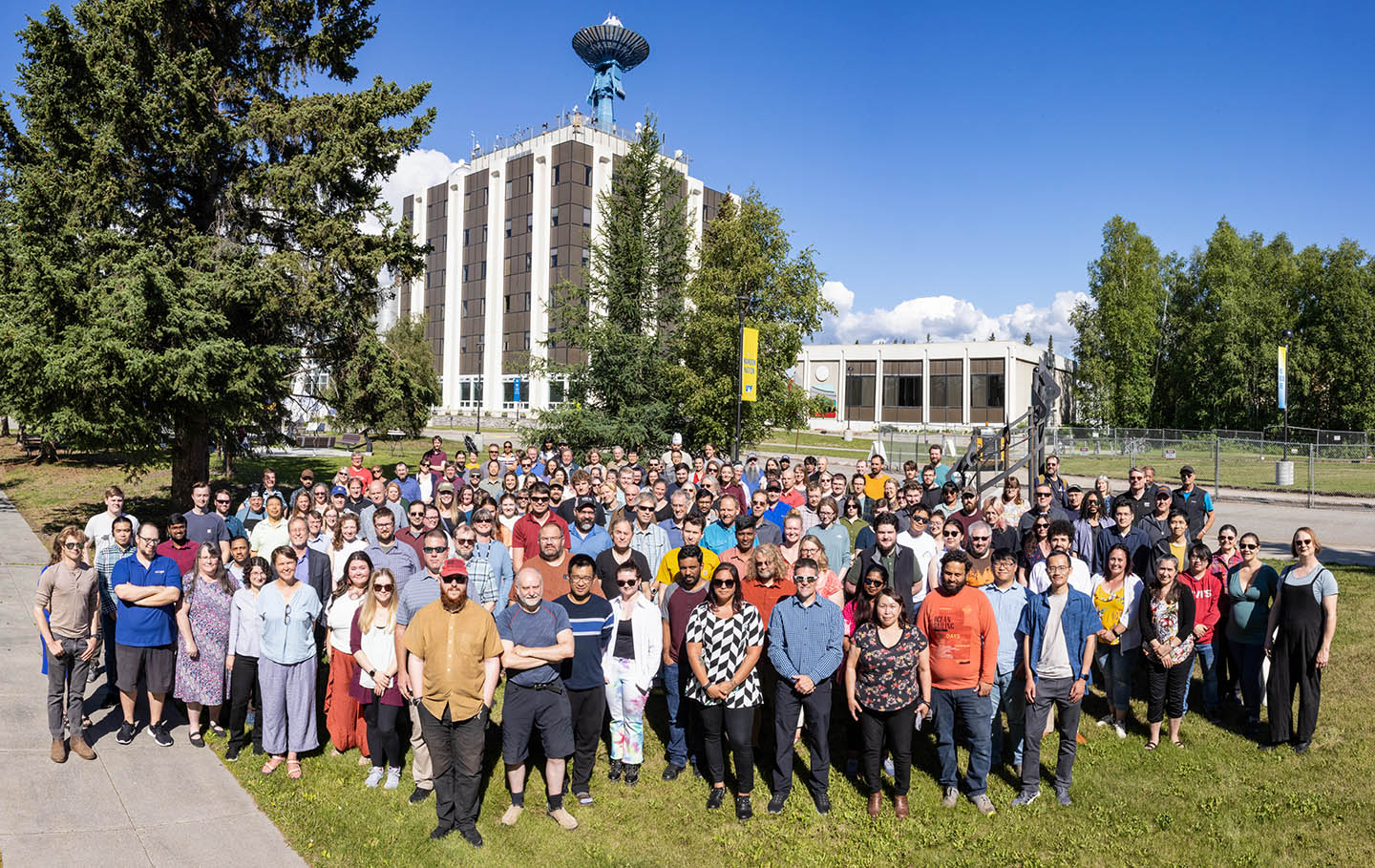
Thank you to all the GI researchers, faculty, staff, students, emeriti and affiliates who showed up on the beautiful sunny afternoon of July 13, 2023, for a group photo. Also many thanks to photographer JR Ancheta for the spectacular results! He stitched together seven different exposures in Photoshop — twice — to make these panorama photos for the GI.
These photos are just the most recent in a long string of similar shots taken over the institute's 75 years. Congratulations, we're all part of the historical record now!
Downloadable versions linked below. Contact LJ Evans at ljevans@alaska.edu if you'd like a higher resolution version for printing.
…
Looking back: Scientists spend nights on top of volcano
Note: This story turns 10 years old this year. I am revisiting it because it shows the uncertainties of doing science outdoors in Alaska. And because I’m off visiting a scientist in the field myself this week. Enjoy.
Leaning into her Thermarest pad pressed against the window of a helicopter coated with ice, Taryn Lopez imagined herself as the little girl rocking to sleep in her parents’ boat.
Just before she drifted off on that early September night 10 years ago, the volcano researcher wondered if the attached climbing ropes would hold the Jet Ranger to the wind-pounded volcano on the spine of the Alaska Peninsula.
“We weren’t sure if we’d wake up the next morning having moved a couple feet,” she said.
In the back seat of the stranded helicopter, John Paskievitch was confident in his improvised anchors, but had a harder time falling asleep. He couldn’t help thinking of the flying-rock windstorms he had experienced in 25 years of fieldwork in…
read more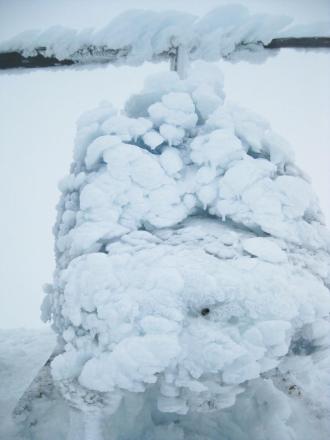
Global Autonomous Systems Conference wraps up
The first Global Autonomous Systems Conference, with about 300 attendees and 100-plus speakers, closed Friday, Aug. 11 in Anchorage. Final comments came from University of Alaska President Pat Pitney and Alaska Center for Unmanned Aircraft Systems Integration Director Cathy Cahill, who announced the conference will be held again in 2024.
The three-day conference was sponsored by the UAF Alaska Center for UAS Integration and hosted by the…
read more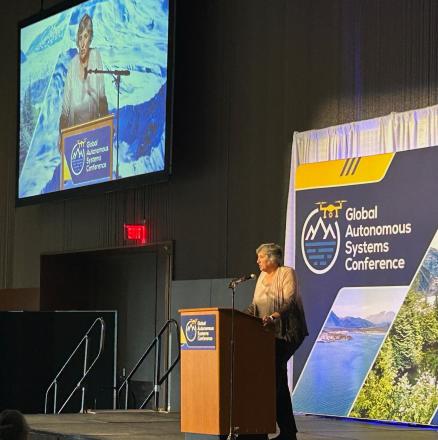
Bering Land Bridge research project underway
UAF researchers aboard the R/V Sikuliaq during August are reconstructing the environment of the Bering Land Bridge prior to it being covered by rising sea water.
The NSF-funded project will collect marine sediments and microfossils deposited in lakes, ponds or bogs that were above sea level during the last ice age. The researchers will employ a gravity corer — a weighted tube that falls through the water and uses gravity to push it into the sediment — to bring samples to the surface for study. In a few places, they will also employ a vibracorer, which uses high-frequency vibration to drive the sampling device into the sediment about 10 meters below the seafloor.
By examining these cores, they hope to reconstruct the vegetation and climate of the Bering Land Bridge when it was above sea level. Results will also shed light on the resources available to human inhabitants and the challenges they…
read more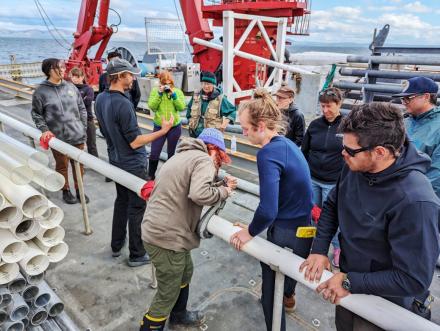
Plants are once again for sale in Mather Library
The GI Plant Hall committee has been busy rooting cuttings and nurturing plants that are now available for purchase in Mather Library! Check back periodically as there will be more plants for sale in coming weeks!
The plants in the GI Plant Hall are entirely cared for by volunteers. Most of the small plants for sale in the library were grown from cuttings from plants in the hall or are from committee members’ own collections. Some of the larger plants were gifts or are duplicates. Though most of the plants available are house plants there are also some that can be grown outside in the summer. The plant hall committee uses the money from these sales to buy supplies and materials like potting soil, fertilizer, pots, plant stands and more. Your purchases support the plant hall!
All plants are labeled with the common name so that you can easily find them online for care information. Please send any additional questions about the plants or plant hall to …
read more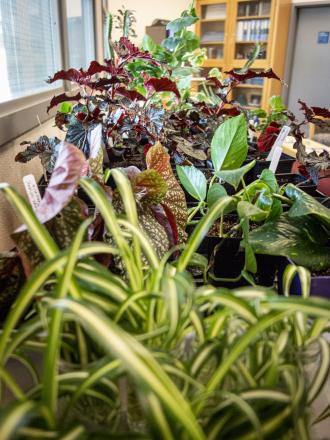
Arctic Research Open House was definitely a hit
It was perfect weather for an outdoor/indoor Arctic Research Open House last Thursday! People visiting the Geophysical Institute were able to see themselves through a hyperspectral camera, learn about different types of ice, meet Pingo Peat the inflatable mammoth, watch a real lava demo, fly a drone with a flight simulator, and tons more!
A commentor on the GI Facebook page said "One of my favorite events every spring! Never disappoints. Family friendly and kid FOCUS (which I love!)."
Lots of Geophysical Institute groups were represented, including the Alaska Center for Unmanned Aircraft Systems Integration, Alaska Climate Research Center, Alaska Coastal Cooperative, Alaska Coastal Geoscience Lab, Alaska Earthquake Center, Alaska Satellite Facility, Alaska…
read more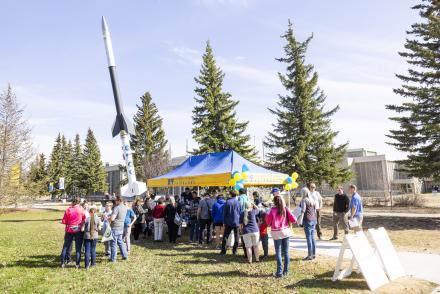
Congratulations, graduates!
Congratulations to all students affiliated with the Geophysical Institute who graduated this year! The GI community extends our congratulations and very best wishes to each of you.
Hunter Barndt completed two degrees from different UAF colleges: a bachelor of science in physics, concentration in computational physics, College of Natural Science and Mathematics; and a bachelor of science in computer science with minor in mathematics, College of Engineering and Mines. Barndt has been working with GINA for the last two years and expects to continue through the summer. Hunter is also a part of the UAF Space Weather UnderGround (SWUG) team with the G.I. on the seventh floor. That is the team he worked with for his senior project and GINA was his my student job.
Two full-time employees of the Alaska Earthquake Center graduated this spring. Gabriel Low received an interdisciplinary bachelor of…
read more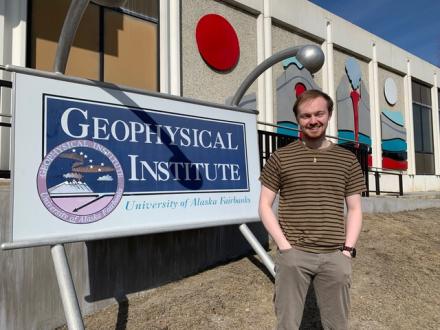
The demise of Scotch Cap lighthouse
In spring of 1946, five men stationed at the Scotch Cap lighthouse had reasons to be happy. World War II was over. They had survived. Their lonely Coast Guard assignment on Unimak Island would be over in a few months.
But the lighthouse tenders would never return to their homes in the Lower 48. In the early morning of April 1, the earth ruptured deep within the Aleutian Trench 90 miles south. An immense block of ocean floor rose, tipping salt water across the North Pacific.
The earthquake was giant, at least magnitude 8.1. The tsunami that resulted killed 159 people in Hawaii, drowned a swimmer in Santa Cruz, banged up fishing boats in Chile and wrecked a hut on Antarctica. The curve of the Aleutians protected much of Alaska, but the five men at Scotch Cap had no chance.
A 130-foot wave struck the lighthouse at 2:18 a.m., leaving nothing but the foundation of the reinforced concrete structure. Though scientists long thought the wave was due to the earthquake…
read more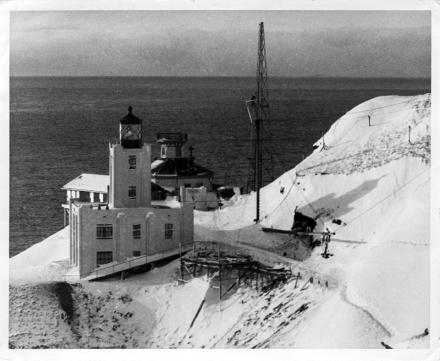
Four Winds entertains in the GI director's office
Roger Smith brought his barbershop quartet, the Four Winds, to the GI on Valentine's Day to sing a few romantic songs. A number of GI people came to enjoy the performance.
For many years, a quartet has come to the GI to sing in celebration on this day. Up until COVID it was a group called The Tanana Flats. On this occasion, a new quartet named Four Winds provided the entertainment.
Barbershop quartets have a lead singer who sings the melody, and bass, baritone and tenor parts which provide harmonious accompaniment.
Four Winds was formed a year ago with Willa Watts as the lead, Dick Holm as bass, Ted Sponsel as baritone and Roger Smith as tenor. We sang the Elton John song “Can you feel the love tonight,” Disney’s “Kiss the Girl,” “Annie’s song" by John Denver and “Smile,” a Barbershop song to blow away the COVID blues. In addition to singing at the GI Director’s Office, we also sang at four other locations in town that afternoon.
Hopefully, we can…
read more JR-22-GI1079-27.jpg (3.69 MB)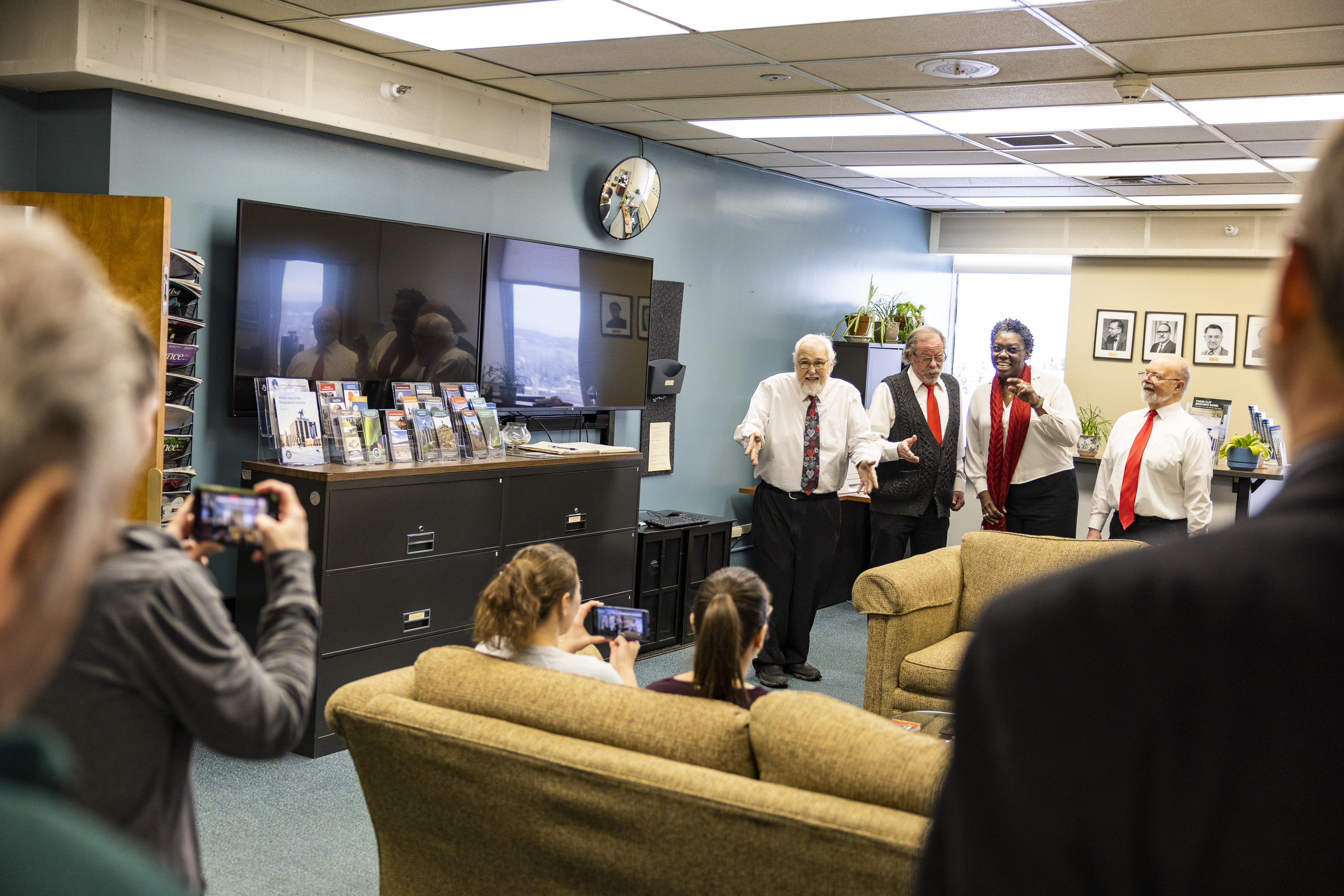
In honor of Black History Month, be Prolyfyck
For nearly a decade we have experienced a political climate that has emboldened racist ideals. Coupled with a global pandemic that isolated us all, the world turned its animosity up to 11. When the pandemic finally started to simmer down, I — like many people — visited family that I had not seen for over two years.
Prior to visiting my brother in Charlottesville, Virginia, last summer, I stumbled upon the intriguing group, Prolyfyck Run Crew. Though running is low on my priority list, after spending many hours in transit, I need to exercise in order to maintain my self-worth. Running is inexpensive, a great pace to experience the environment around you, and you can safely do it in many places around the world.
Prolyfyck supports walking/running routes in Charlottesville’s historically Black neighborhoods in order to encourage exercise and foster community. They have an inclusive mindset, positive approach to exercise, and…
read more
New format, new venue for Science for Alaska kickoff event
The 31st Science for Alaska lecture series kicked off Friday, Feb. 3, with a new format and a new venue. Six researchers presented their work in short visual-centered talks in the UAF Pub. The lineup reflected just a sliver of the wide variety of the research that goes on at the Geophysical Institute.
The speakers were:
- Franz Meyer, Alaska Satellite Facility
- Harper Baldwin, Arctic Coastal Geoscience Lab
- Victor Devaux-Chupin, Snow, Ice and Permafrost Group
- Bill Simpson, Atmospheric Sciences Group
- Revathy Parameswaran, Seismology and Geodesy Group
- Evans Callis, High-frequency Active Auroral Research Program (HAARP)
A large and enthusiastic crowd showed up. Staff at the door said they handed out more than 100 door-prize tickets. The event was so successful that the GI Public Information Office, which organized the event, is considering repeat events a few times a year.
The lecture…
read more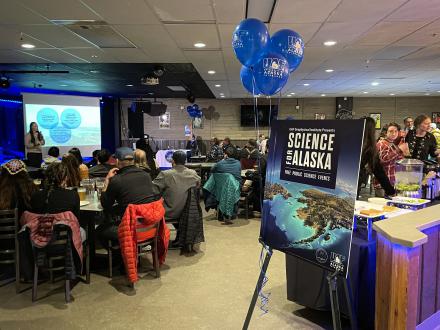
New faces at the GI: Michael Roddewig
Michael Roddewig joined UAF Oct. 16 as assistant professor in a dual appointment between the Geophysical Institute and the Department of Electrical Engineering in the College of Engineering and Mines. Contact Roddewig at mrroddewig@alaska.edu or 907-474-5936.
…
read more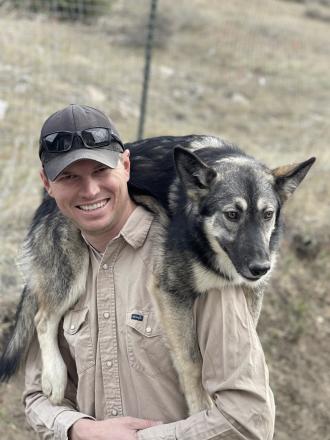
New faces at the GI: Holly Dean
Holly Dean joined UAF Oct. 10 as science librarian at Rasmuson Library. She will be spending part of her time in Mather Library in the Akasofu building, initially on Tuesdays, in 202B. She can be reached at hmdean@alaska.edu or 907-474-6458.
What made you want to come to work for UAF?
The Geophysical Institute and UAF have always been a part of my life. I grew up visiting my dad (Ken Dean, Research Professor Emeritus in the remote sensing group, and AVO north) in his office in the GI, and later as an undergraduate student I worked in the Mather Library next door to the map office in IARC where my mom worked. My husband and many of our friends did their graduate work through the GI as well, so these places all feel like home to me.
The breadth and depth of research conducted here is as fascinating as it is…
read more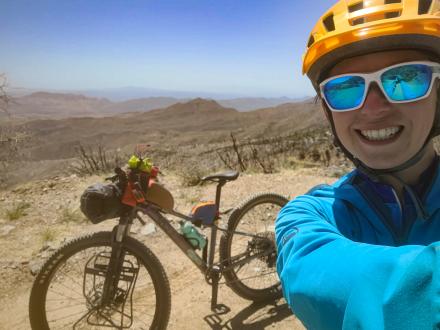
Remembering Beatriz Roederer
We are sad to note the death on September 12 of Beatriz Roederer, wife of former Geophysical Institute director Juan Roederer.
An article in the Fairbanks Daily News-Miner in 2012 commemorating the Roederer’s 60th wedding anniversary sketched out the story of the Roederers' careers and their lives in Fairbanks.
Juan and Beatriz were born in Europe 250 miles and two weeks…
read more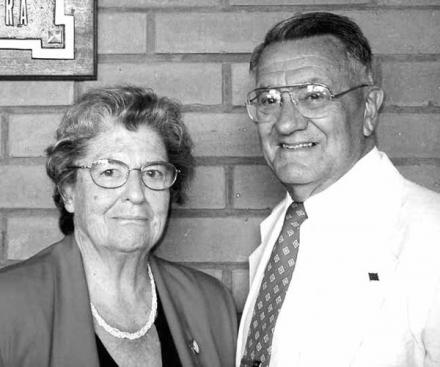
Remembering Celia Rohwer
We regret to share the news that longtime employee of the Geophysical Institute Celia Rohwer died on Sept. 3, 2022 in a motorcycle accident. Celia was a software developer and worked for many years in the Computer Resource Center. There will be a memorial service at 3 p.m. Saturday, Sept. 17 at University Presbyterian Church. Remembrances of Celia from colleagues at the GI are included below.
Roger Smith
Celia Rohwer died September 3, just 4 miles short of Haines on the Haines Highway. She and her husband David were riding on separate motorcycles for the ferry to Bellingham at the time. David was in the lead and heard a cry from Celia on the helmet communication, but then silence. He went back to find what had happened and found that she had crashed into the ditch on the side of the road on a bend. He called for help but the EMTs could not revive her.…
read more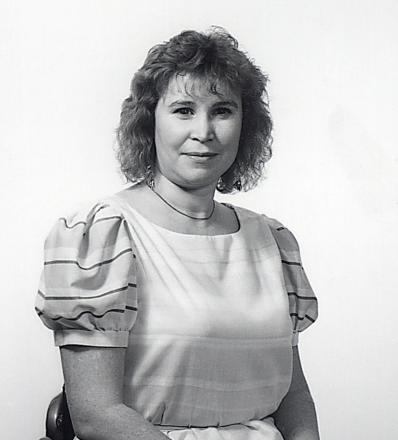
Send us your fieldwork photos!
GI researchers and technicians do their fieldwork in so many different places, from the fabulous to the ordinary. But even the most ordinary of places can prove to be challenging for science while the most fabulous can be a breeze. And both can present the unexpected.
Whether on land, on water or in the air, we know the field is where you want to be.
We’d like to share your fieldwork experiences with the GI audience as well as the world, including on Twitter for the #FieldworkFriday hashtag that shows what your colleagues at other institutions have been up to out in the field.
Send your photos to uaf-gi-public-info@alaska.edu. Please include a brief bit of info and a photo…
read more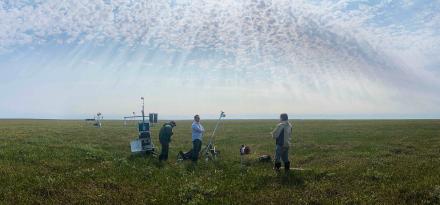
NASA unveils Webb’s first images
This morning at 6:30 a.m. Alaska time, NASA rolled out five images gathered in the last few weeks from the James Webb Space Telescope, the largest and most powerful space observatory ever built. The telescope, launched in December 2021 on a European Space Agency rocket, is expected to be the world’s premier observatory for at least the next decade, serving thousands of astronomers and other scientists across the globe.
The GI's Gunther Kletetschka was involved with final development of …
read more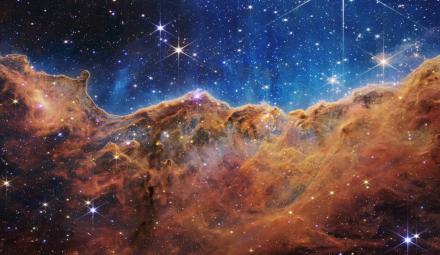
Utqiagvik, where there’s still snow in June
A group of University of Alaska Fairbanks faculty, students and staff has been in Utqiagvik since mid-May to measure snow melt, but the melt only started this week.
This is an exceptionally late melt year.
The SALVO Team has been working hard through the midnight sun, which never sets in Utqiagvik.
The team includes Jennifer Delamere, Matthew Sturm, Melinda Webster, Anika Pinzner, Phillip Wilson, Ema Mayo, Serina Wesen, Hannah Chapman-Dutton and Owen Larson, all from UAF. The team also includes David Clemens-Seawall from Dartmouth and David Shean with the University of Washington.
We did not think we would be riding snowmachines in mid-June and still wearing snow pants in summer.
Currently, melt ponds are starting to form, and we are still able — carefully — to go out to one of our study sites on the Chukchi Sea ice. Some of our regular measurements include snow pits, snow grain sizes, bottom temperature snow measurements,…
read more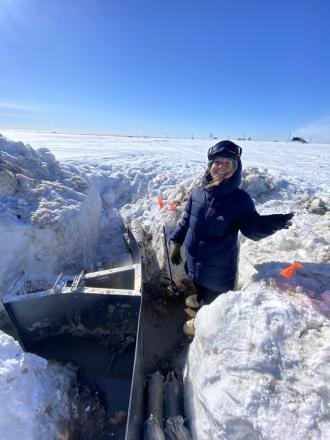
Wildfire in the Interior: Where to find the information you need
Maybe it’s time we should think about freshening up our emergency plans, take a look at sources for information and pack the “GO!” bag?
“The current wildfire activity is indeed bad, and scary given that there is no change to a more humid weather situation (forecast) at least for this week,” said Martin Stuefer, Alaska State climatologist and director of the GI’s Alaska Climate Research Center. One of many resources available to Interior residents is the UAFSmoke map published online and maintained by his unit. One of the particularly useful data streams in the UAFSmoke website is the forecasts of particulate matter in the smoke resulting from wildfires.
“Wildfire smoke includes of course more than particulate matter, but it is especially PM2.5 that people care about. UAFSmoke is updated hourly, and the smoke forecast model is running daily.”
More resources
…
read more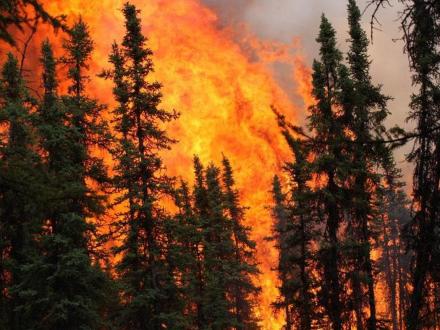
The world according to a dog’s nose
When a Lab vacuums the ground with her nose and her tail moves like a helicopter blade, you know a grouse is about to fly. When the dog stops like a dragonfly, then runs off sniffing an invisible path, a snowshoe hare has crossed your trail.
All this entertainment is courtesy of that most sensitive appendage, a dog’s nose. It’s an instrument man has not been able to duplicate. Search-and-rescue groups use dogs to find lost people, dead people, and people buried under earth and snow. Dogs have also been used to find seals on ice, gas leaks and the presence of spongy moth egg sacks.
Lurking behind those textured, damp nostrils are sensitive membranes that allow a dog to distinguish smells—molecules of odor that emanate from every living or once-living thing—at least one thousand times better than humans.
A dog processes odoriferous molecules more readily because a dog has a much larger set of scent membranes within its nose, explained Robert Burton in his book…
read more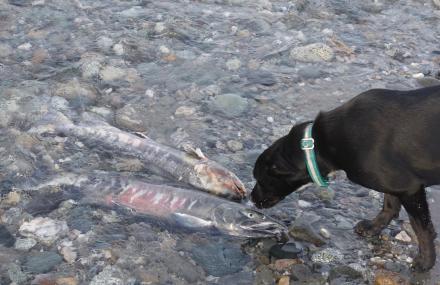
Remembering David and Barbara Stone
I've known David and Barbara Stone for 30 years. David was the one who recruited me to come to UAF. I came up with a young family, we actually stayed a couple days at their place before we found a temporary home. They kind of adopted me and my kids and my wife. They were just so gracious. They always asked about how everybody was doing and really cared about my family. For me, that was always very gratifying.
David was a renowned scientist with a specialization in paleomagnetics and tectonics. We wrote several papers together and we were in the field working on several projects. I went to Russia with David a couple of times in the early 90s and we did fieldwork there. On one of those trips Barbara came along. We were in Yakutsk and I think David was off working with one of the scientists, so Barbara and I went exploring. We wanted to buy something in a store. Our Russian wasn't very good, but we found something we wanted, and we tried to figure out how to buy it in this…
read more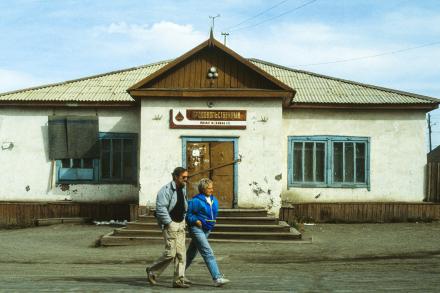
AGU: Building the booth
The UAF booth at the annual American Geophysical Union Fall Meeting is the result of many hours’ work by many people.
Planning for the booth each year starts months in advance. Decisions must be made about how much space the booth will need, where it will be located in the exhibit hall and what furniture needs to be rented from the exhibit contractor. Those decisions are led by the booth manager — for the last couple of years Kelly Eagan of GI Communications has held that post. She collaborates with others, including GI Communications Director Lynda McGilvary and representatives of other UAF units that help with the cost and staff the booth.
At the booth’s heart stands the tower.
Selection and then design and production of the graphics for the tower, made of aluminum and currently the main element in the booth at 13 feet tall, took place in 2018 in preparation for AGU’s first appearance in Washington, D.C.
“We wanted to make a good…
read more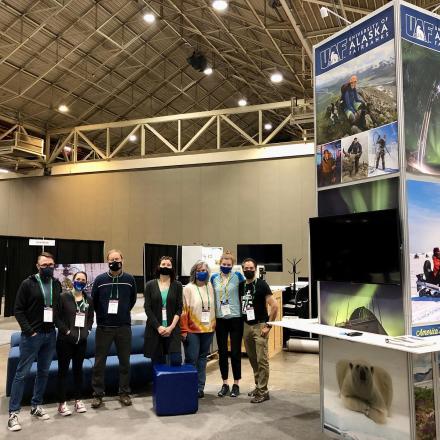
GI press release inspires poem about magnetic nanoparticles
The GI Public Information Office received a nifty email from Scotland this week.
"Hello, I was inspired to write a poem for my weekly blog about the amazing research featured in your press release! I have let the researchers know, but I thought I'd send it to you as well, having read your excellent account."
"Many Thanks,
Dr Sam Illingworth
Associate Professor in Academic Practice
Department of Learning and Teaching Enhancement
Edinburgh Napier University"
Shattered Magnetism
by Sam Illingworth
Cloaked in weathered loam
fraying edges sink from view,
the violence of a distant past
now hidden in the horsetails
that lie littered in decay.
Delicate grooves radiate…
read more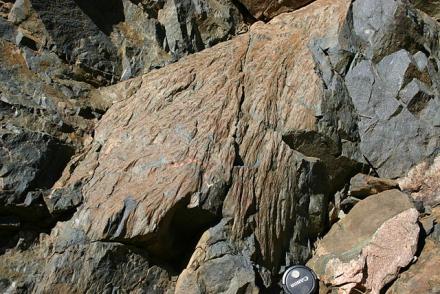
New tile mural commemorates 75th anniversary
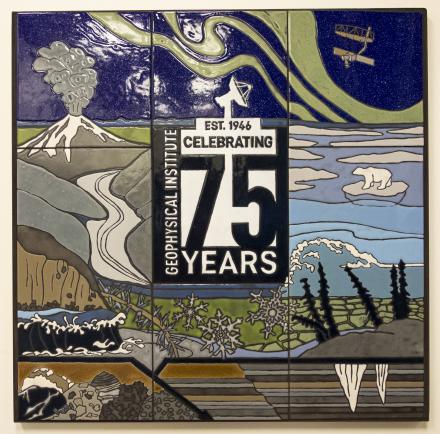
GI Director Bob McCoy introduced artist Nancy Hausle-Johnson on Tuesday, Nov. 9, as she unveiled the new tile mural she created for the Elvey Building lobby as a commission to celebrate the GI's 75th anniversary.
The tile mural was created by Hausle-Johnson, whose husband, Jerry Johnson, was a GI postdoc with Lew Shapiro. Great care was taken to make sure that the installation represents, in some way, each of the GI's diverse research groups. You can learn more about Hausle-Johnson’s work here.
Remembering Gerd Wendler
Gerd Wendler, professor emeritus at the Geophysical Institute, died Wednesday, Oct. 13, following a bout with cancer.
Gerd was born in Hamburg, Germany. He received a Ph.D. in atmospheric science in 1964 from the Leopold Franzens University, Innsbruck, Austria. In 1967 Keith Mather, at that time director of the GI, offered Gerd a permanent position as an assistant professor. His field of interest was climatology and glacio-meteorology with special emphasis on the polar regions, both the Arctic and Antarctica, on which topics he published widely. The university granted him Professor Emeritus of Geophysics in 1999, but he continued to direct the Alaska Climate Research Center until 2017. One of the accomplishments lauded in his emeritus resolution was his work with a French team installing a network of automatic weather stations on the Antarctic ice sheet which…
read more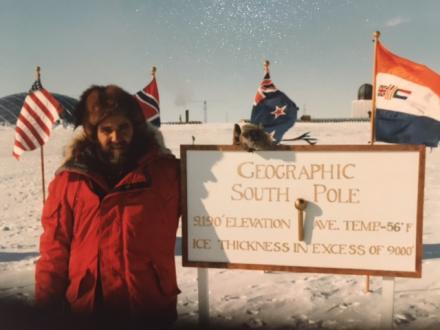
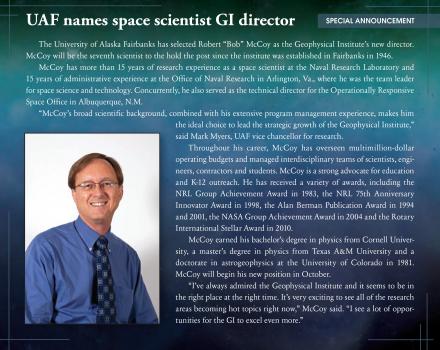
Bob McCoy's first decade at the GI
Robert McCoy became director of the GI on Oct. 14, 2011. We asked a few GI people to share their thoughts about some of the important things he's accomplished in those 10 years.
-
Diversity is important to Bob, as is having a safe and professional working environment. He has worked to hire more women into leadership positions at the GI. For example, he hired Cathy Cahill as director of ACUASI, Kathe Rich as director of Poker Flat, Nettie La Belle-Hamer as the first female GI deputy director ever, with a focus on growing research, Gwen Bryson as manager of RCS, Jessica Larsen as associate director, Jenn Delamere at GINA, Lillian Misel as executive officer, Jessica Matthews as manager of HAARP, as well as others.
-
He wanted to make science on UAF's West Ridge more visible, so he championed the sounding rocket from PFRR in the park mall in front of Elvey, and the Planet Walk extending all the way across campus.
-
Five…
GI history nugget: Construction of the Elvey Building
The C. T. Elvey Building on West Ridge was built between 1968 – 1970 to house the expanding Geophysical Institute. The 85,000-square-foot building cost $4.1 million to construct; the building's architect was Linn Forrest of Juneau and the contractor was Peter Kiewit Sons of Nebraska and Fairbanks.
The building was dedicated Sunday, May 18, 1969, following the university’s commencement ceremonies. Christian T. Elvey had been the director of the GI from 1952 to 1963. During the dedication ceremony, the plaque which now resides in the Elvey Building foyer was unveiled. In remarks that day, then GI Director Keith Mather noted that Elvey was commemorated on the plaque as astronomer, geophysicist and leader. “Distinction won in a single field of human endeavor is enough for most men,” Mather said. “Dr. Elvey won national and international tribute in all three.” Elvey died March 1, 1970, so he unfortunately never saw the completed building.
The main construction was put…
read more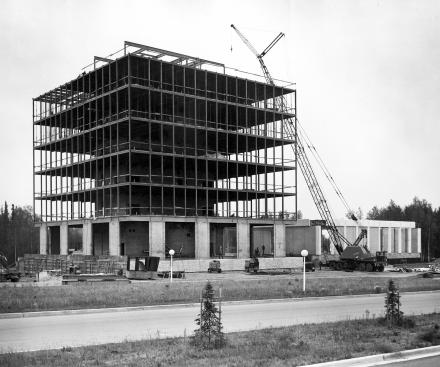
GI History Nugget: The international signpost backstory
There are a couple of accounts about the origin of the Geophysical Institute’s international signpost. The narratives are similar, but they vary on a few particulars.
The official history of the signpost was written by former GI director Keith Mather as a memo to his successor, Juan Roederer, in July 1986.
“It all began at a luncheon with Paul Smith [and others] at the Cosmos Club on 21st Street, N.W, in Washington, D.C.” Mather said.
Admiral Paul A. Smith, Ret., was a long-time member of the Geophysical Institute Advisory Board. The referenced luncheon took place Wednesday, Nov. 29, 1972, Mather said.
“Since [completion of the Elvey Building in 1970], I had been toying with the thought of something — some symbol — that would betoken the lnstitute's international connections and also be a decorative feature on the Mall,” Mather explained in the memo.
“Ideas got tossed around and we talked of the Institute, the University, the future. The possibilities…
read more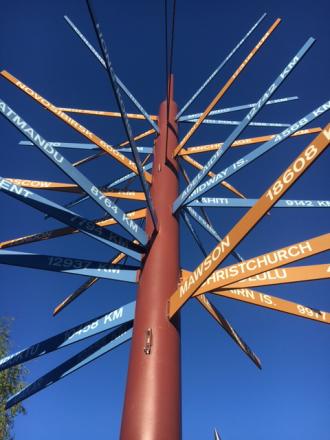
GI history nugget: Sputnik another GI first
During the late 1950s, the Geophysical Institute focused on preparing to participate in the important International Geophysical Year, a worldwide 18-month coordinated project to measure Earth's physical characteristics which ran from July 1, 1957 through Dec. 31, 1958. Sydney Chapman, GI's advisory scientific director from 1951 – 1970, had participated in the earlier International Polar Year research in 1932 and was instrumental in launching the IGY.
Just as the IGY was starting up, the institute played an unexpected role in a technical coup by the Soviet Union. The Oct. 4, 1957, launch of Sputnik was the most exciting event of the 1950s, the beginning of the space age! The eyes of the Western World turned skyward. The first scientists to see the new object were Geophysical Institute graduate students Robert Leonard and Joseph Pope, using the interferometer (radio-telescope) converted to a satellite receiver, at the Ballaine Lake Mini-Track Station.
Listening in…
read more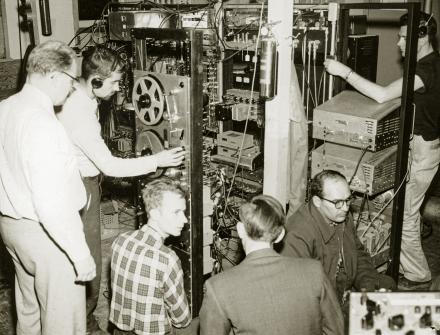
GI history nugget: Chapman Building completed
In 1948, the U.S. Congress appropriated $975,000 for construction of an earthquake-proof three-story building for the fledgling Geophysical Institute. On Emeritus Day, July 1, 1949, newly chosen UA President Terris Moore, President Emeritus Charles Bunnell and Stuart Seaton, the Geophysical Institute’s director, laid the cornerstone for what is now known as the Chapman Building. When the building was completed in 1950, it was considered the finest research facility of its kind in the United States.
In 1951, President Moore began assembling a first-rate research staff for the newly created Geophysical Institute. He asked professor Sydney Chapman to be the advisory scientific director. Under Chapman, the GI became the core of the university’s research and graduate programs.
The 19,000-square-foot building boasts an observation deck of an…
read more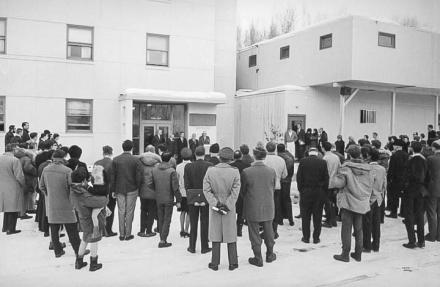
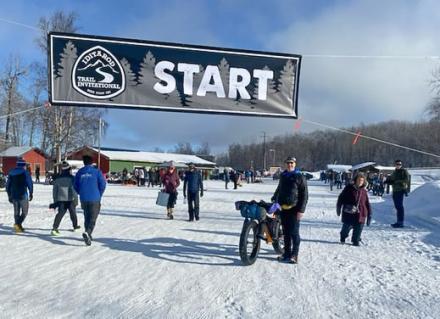
Space physicist Peter Delamere of the UAF Geophysical Institute and UAF College of Natural Science and Mathematics is pedaling away in the Iditarod Trail Invitational, an event that…